
Flash Memory Factory — How TF Cards, UDP Modules and USB Drives Are Made
This page is about how the products are made, and what that changes for a buyer. A flash memory factory does not manufacture silicon — it sorts and tests incoming die, bonds or places it onto a board, pairs it with a controller, assembles and marks it, then verifies capacity and read/write performance before packing. WINTEL runs that chain in-house in Shenzhen. The commercially relevant part is where in the chain a supplier can quietly change the product: die grade and controller choice are decided at stages one and two, long before anyone looks at the finished card. If those two are fixed in writing, the rest of the chain is checkable.
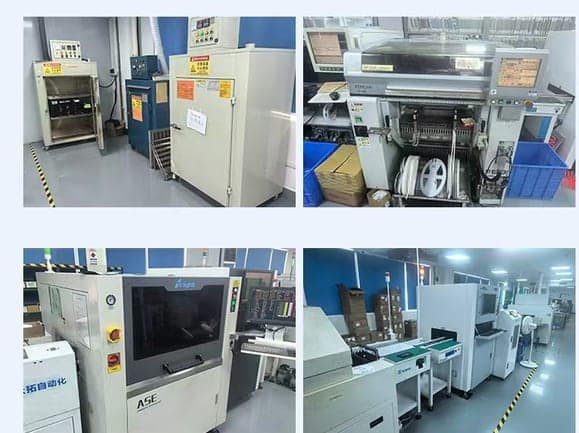
The production chain, stage by stage
| Stage | What happens | Why it matters commercially | What to ask |
|---|---|---|---|
| 1. Wafer sorting & testing | Incoming die is screened and graded before it is packaged or bonded. | Grade is decided here. This is where "A+ grade" either means something or does not. A factory that buys pre-packaged parts never sees this step. | Ask which sources and which grade a given batch came from. |
| 2. COB bonding / SMT placement | Bare die is bonded directly to the PCB (COB), or a packaged part is placed by SMT machine. | The die format — TSOP, BGA, LGA, COB or eMMC — and the controller package are set here against your capacity and mechanical constraints. | Ask for the die format and controller package in the specification. |
| 3. Controller pairing & firmware | The controller is paired with the flash and the firmware configured for the target capacity. | Controller compatibility is the most common cause of a part that does not enumerate reliably on the host. It is rarely a capacity problem. | Ask which controller solution is proposed and why, against your host. |
| 4. Housing & assembly | Metal, PVC or wood housing, or the module is left bare for board-level integration. | Where you have your own housing or assembly line, you can enter the chain here by ordering a UDP module or a semi-finished board. | Ask what the mechanical drawing says about clearance and enclosure fit. |
| 5. Marking & branding | Silk-screen printing, full-colour printing or laser engraving to your artwork. | The method follows the material. A technique suited to metal will not perform the same way on PVC — so body and method are confirmed together. | Approve a physical sample before bulk production, not after. |
| 6. Test & pack | Capacity and read/write verification, then packing to bulk, retail or presentation packaging. | This is the last point where a bad unit can still be caught. Under-capacity cards are the single most reported failure in this product category. | Verify independently with H2testw — the method is published on our testing page. |
The five-stage version of this chain, as we document it internally, is on the manufacturing process page.
Where a supplier can change the product without telling you
| Risk | Where it enters | What controls it |
|---|---|---|
| Capacity overstated | Stages 1–3 | Fix capacity and die grade in the specification; verify the finished unit with H2testw before accepting the batch. |
| Silent substitution | Stages 1–2 | Fix silicon source and controller in writing. Without it, a shortage becomes a substitution you are told about afterwards. |
| Controller incompatibility | Stage 3 | Validate a sample on your own host before committing to volume. Enumeration failure is a controller problem far more often than a capacity problem. |
| Mixed silicon inside one batch | Stages 1–2 | Ask how batch homogeneity is maintained. Mixed silicon produces field failures that are expensive to trace. |
| Branding does not match the proof | Stages 4–5 | Approve a physical sample. Colour accuracy depends on the body material and print method. |
These are the failure modes buyers report in this product category. Naming them is more useful to a buyer than claiming they do not happen.
What this factory does and does not do
Does
- Sort, test and grade incoming flash die
- Bond or place the die and pair it with a controller
- Assemble metal, PVC and wood housings, and bespoke moulds
- Apply silk-screen, colour print and laser marking
- Verify capacity and read/write performance before packing
Does not
- Fabricate NAND wafers — no card factory does
- Act as an authorised distributor for any NAND brand
- Publish a capacity figure we have not confirmed
- Claim a certification we cannot produce a certificate for
Factory facts
- Operating entityShenzhen Wintel Digital Technology Limited
- LocationShenzhen, Guangdong, China
- Factory floor5,000 m²
- Monthly capacity[Add monthly capacity]
- Headcount[Add headcount]
- Export markets50+ countries
Discuss your product with the people who build it
Send the product type, capacity, quantity, application and target date. We reply to business enquiries within 1 business day.
Request a quoteFrequently asked questions
Do you manufacture the NAND flash itself?
No, and no card or module factory does. NAND is produced by semiconductor manufacturers — SanDisk, Toshiba, Micron, SK Hynix, Intel and Samsung, among others. What a flash memory factory does is sort and test incoming die, bond or place it, pair it with a controller, assemble it and verify it. We are a flash memory manufacturer in that sense, and we are not an authorised agent or distributor for any NAND brand.
What does "A+ grade" mean?
It is a sorting grade applied to flash die, not a standard with a single definition across the industry. What matters commercially is that the grade is stated on your quotation and that the finished batch can be verified against it. Ask for the sourcing breakdown on your specific project.
Can I enter the process partway — for example, buy the board without the housing?
Yes. If you have your own housing or assembly line, order a UDP module (11.3 × 24.8 × 1.45 mm) or a semi-finished board (12 × 44 × 4.5 mm) and take it from there.
How do I verify a batch myself?
Use H2testw, a free capacity verification tool that writes and reads back the full capacity of the card. The method is described on our memory card testing page, and it works on any card from any supplier.