
A factual comparison of TF cards and UDP modules (USB Disk in Package) — form factor, integration method, cost, counterfeit risk, and which to choose for consumer devices versus embedded PCBs.
TL;DR
A TF card is a removable, slot-based consumer form factor. A UDP module (USB Disk in Package) is a bare module soldered or bonded directly onto a PCB. Choose TF cards for devices with a card slot; choose UDP modules for embedded, space-constrained or sealed designs.
The decision is rarely about storage size. It is about whether the device should be able to lose its memory, and who pays for that when it does.
The two formats side by side
| Factor | TF Card | UDP Module |
|---|---|---|
| Form factor | 15×11×1mm, removable | 11.3×24.8×1.45mm, fixed |
| Integration | Card slot | Direct PCB mounting |
| Interface | USB2.0 (via reader) | USB2.0 / USB3.0 |
| Capacity range | 4G – 256GB | 128MB – 128GB |
| Weight | 0.25g | 0.819g |
| Best for | Dashcams, cameras, phones | IoT, industrial, embedded systems |
Weight is not a typo. A UDP module with its housing weighs more than a bare card, because the housing is part of the part. If weight is a hard constraint at the board level, that matters.
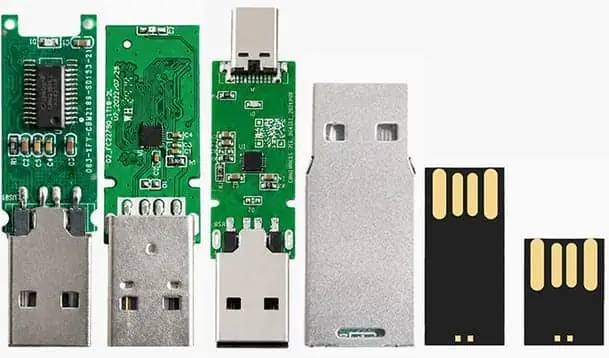
A third option sits between them and deserves a line in any serious comparison: the semi-finished board, at 12 × 44 × 4.5 mm, 3.2 g, 128MB to 128GB. That is a populated PCBA with the housing already decided, for buyers who want their own enclosure around a known-good board rather than a card or a bare module.
What actually changes when you solder it down
The physical difference is small. The consequences are not.
Vibration and shock. A card sitting in a spring-loaded socket is a mechanical part that cycles every time the device moves. Automotive, industrial and hand-held products all have a failure mode here that has nothing to do with flash at all: the card works loose, or the contact intermittently fails. A bonded module has nothing to work loose.
Airflow and heat. A card in a sealed enclosure is often the only thermal path the storage has. A module behind a shield or under a heatsink can be placed deliberately. This is a board-layout decision, and it has to be made before the enclosure, not after the card is chosen.
Serviceability. This is the trade you are explicitly buying. A removable card can be swapped in the field; a bonded module cannot. If your product’s storage is also its firmware update path, then a sealed module turns every future firmware decision into a hardware one.
Interface choice. Most UDP programmes ship on USB2.0, which is sufficient for a logging, telemetry or firmware-update workload. Only move to USB3.0 if your host genuinely sustains a transfer rate that USB2.0 cannot carry, because the faster interface also costs more in routing, shielding and controller.
Counterfeit exposure. Removable media passes through more hands between the wafer and the end user, which is exactly where relabelled and capacity-inflated stock enters the market. A module that you bonded into your own board, in your own factory, on your own line, has no such channel. For a product with a brand reputation attached, that is often the deciding argument rather than the cost one.
Which should you choose?
Choose a TF card when your product already has a card slot, or you want field-upgradable storage. It is the fastest path to market and familiar to end users.
Choose a UDP module when the storage must be permanent, compact and vibration-proof — common in industrial controllers, medical terminals and IoT devices. Because it removes the connector and housing, it also tends to win on unit cost at scale.
Choose a semi-finished board when the value you want is “a known-good populated board, in my own enclosure” and you do not want to own the SMT process. The board is built on the same line as the modules; what changes is that the housing decision moves to you.
Both are built on the same A+ grade flash and controller solutions at WINTEL, so quality stays consistent across form factors. One qualification exercise can cover both, which matters if a product line needs a retail SKU and an embedded SKU.
What the switch actually costs you
Buyers usually look at unit price and stop. Five other costs move in the other direction:
- Tooling. A module goes on the PCB by placement and reflow, so it needs your assembly line, your stencil, and a design for test. A card needs a socket in the enclosure and nothing else.
- Test fixtures. A board with a bonded module has to be tested as a board. If you have never built an in-circuit test fixture, this is a project cost, not a line-item cost.
- Field service. A removable card can be replaced in the field. A soldered module cannot. If your product has a service life longer than its storage, that changes the maths entirely.
- Capability ceiling. UDP tops out at 128GB. If your roadmap passes that, a card slot is the only path.
- Design lock-in. Changing a bonded module later means a board revision. Changing a card later means a purchase order.
None of these are reasons to avoid modules. They are reasons to make the decision before the enclosure, not after.
When neither is right
Some products should not have their memory decision made for them by unit price:
- You need removable media for a regulatory or operational reason. Some inspection devices and body-worn cameras are specified around removable evidence media. A fixed module is technically fine and practically wrong.
- Your storage roadmap will pass 128GB. UDP has a ceiling; a card slot does not.
- You have no in-house PCB assembly. A module still lands on a board somewhere. If that is your first board and you have never done assembly, a finished card or a semi-finished board carries far less onboarding risk.
- You are quoting a very small first batch. Module setup cost per unit is punishing at low volume. Start with whatever ships, then move down the stack.
- Your device has no USB path at all. A UDP module is a USB device. If your host talks to storage over SPI or eMMC, you are looking at a different part entirely, and neither format here is the answer.
Sourcing notes
If you are comparing quotes across formats, compare them on the same basis. Ask each supplier:
- Does the price include the socket, or the placement? Those are different line items, and only one of them applies to you.
- Is the capacity quoted the same as the capacity you tested? Verification method differs between a card and a bonded module, and the usable figure moves with temperature.
- What happens to tooling and artwork if the order reruns next year?
- Which stages does the factory own? For a module, this matters more than for a card — if the board is built elsewhere, the quality argument for factory-direct collapses.
- Can you supply both formats from one qualification? If a product line needs both, a single supplier who owns both saves a round of duplicate testing.
We publish the method behind our capacity verification on the testing page, because a buyer who cannot reproduce the test cannot trust the number.
Tell us the host, the target capacity, and whether the device can be opened. That is enough to say which format fits before pricing either.
Reach the team at cathy@go-wintel.com or open the request a quote form.
Related reading: UDP vs COB vs PCB, TF vs USB vs UDP: which to buy, TF card vs MicroSD.
Frequently asked questions
When should I use a UDP module instead of a TF card?
Use a UDP module when storage must be fixed directly onto a PCB with no removable slot — typical for embedded and industrial devices where the card cannot come loose.
What does UDP stand for?
UDP stands for USB Disk in Package. It is a bare flash module with a USB interface, mounted directly onto the host PCB rather than inserted into a socket.
Can UDP modules use USB3.0?
Yes. WINTEL UDP modules support both USB2.0 and USB3.0 interfaces, with capacities from 128MB to 128GB.
Which is lower cost at volume?
UDP modules are typically lower cost per unit at high volume because they remove the card connector and housing. Exact pricing depends on capacity and order size — contact us for a quote.
Do I lose the ability to update the firmware later?
With a fixed module you give up field-swappable storage. If your product needs serviceable memory, a card slot is still the right answer, even at higher unit cost.
Are TF cards more at risk of being counterfeit?
Removable media passes through more hands between wafer and end user, which is where relabelled and capacity-inflated stock appears. A module bonded into your own board has no such channel.
Can WINTEL supply both formats in the same programme?
Yes. Both are built on the same A+ grade flash and controller solutions, so a product line can ship a card version and a soldered version from the same qualification work.