
Read and write speed is customizable per order — useful only if your RFQ names the number, the capacity band and the test condition. Five lines turn a soft spec into a quote you can compare.
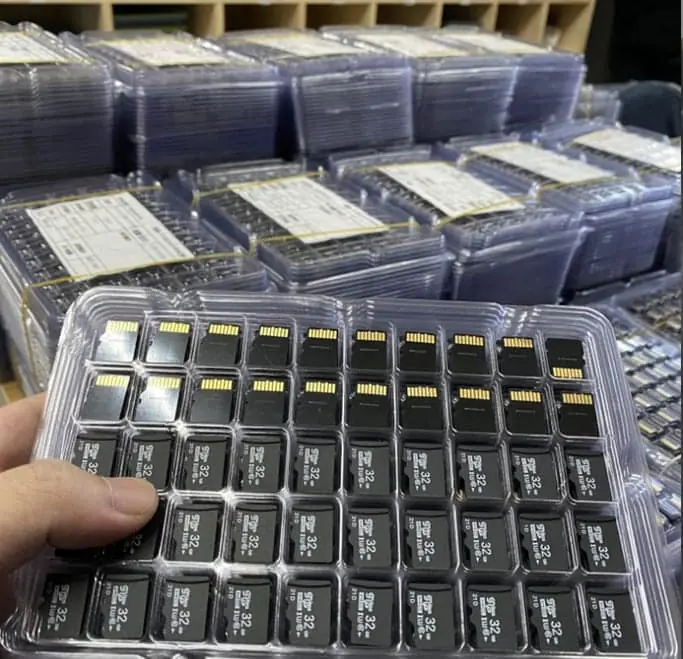
Read and write speed is customizable per order, so a quote that only says customizable cannot be compared with another quote. The figure moves with the capacity band, the controller solution, the NAND package and the host interface. Ask for five lines instead: a sustained sequential write floor in MB/s, the capacity band the figure was taken at, the interface generation, the test condition, and what happens if a shipped unit measures below the line. Read and write speed is customizable per order across our TF card, UDP (USB Disk in Package) module and semi-finished board. Write the number into the purchase order and it becomes acceptance rather than marketing.
TL;DR
Read and write speed is customizable per order, so a quote that only says ‘customizable’ cannot be compared with another quote. The figure moves with the capacity band, the controller solution, the NAND package and the host interface. Ask for five lines instead: a sustained sequential write floor in MB/s, the capacity band the figure was taken at, the interface generation, the test condition, and what happens if a shipped unit measures below the line. Read and write speed is customizable per order across our TF card, UDP (USB Disk in Package) module and semi-finished board — the same three shapes, three sets of limits. Write the number into the purchase order and it becomes acceptance rather than marketing.
‘Customizable’ is not a figure you can compare
A buyer sits with two quotes for the same enclosure. One says 30 MB/s. The other says ‘read and write speed: customizable’. The second line is not softer than the first, it is emptier: it tells nobody what the part will do, and it lets whichever side writes the acceptance document later decide what the shipped unit was supposed to reach.
Speed being customizable is a real description of how the product is built. Read and write speed is customizable per order across every format we produce, and the reason is mechanical rather than legal. A 4GB and a 256GB unit are different assemblies, a different controller solution and a different test plan, so a single fixed line printed on a catalogue would be wrong for most orders. The problem starts the moment the word customizable arrives without a number beside it.
What actually moves the number
Four things move a sustained speed figure, and none of them is the printing on the card.
Capacity band. A controller drives fewer NAND die in parallel at 128MB than at 128GB, and parallel die are how a flash part reaches a higher bytes-per-second figure. A number quoted at one end of the range is not a promise about the other end. Our TF card runs 4GB to 256GB, while the UDP (USB Disk in Package) module and the semi-finished board both run 128MB to 128GB, so the band is fixed by the envelope before any speed discussion starts.
Controller solution and package. The controller solutions on our records are Alcor, ITE, Xinbang and Micov, in QFN, 24-pin, 48-pin and COB packages. Two orders built on different controller solutions can reach different sustained write rates at identical capacity.
NAND package and source. Packages in current use are TSOP, BGA, LGA, COB and eMMC, sourced from SanDisk, Toshiba, Micron, SK Hynix, Intel and Samsung. Package choice constrains how the die can be wired into the controller; source choice constrains what that die will hold.
Host interface. A figure measured on one host controller is not the figure the buyer will see in the field, and no supplier can change that.
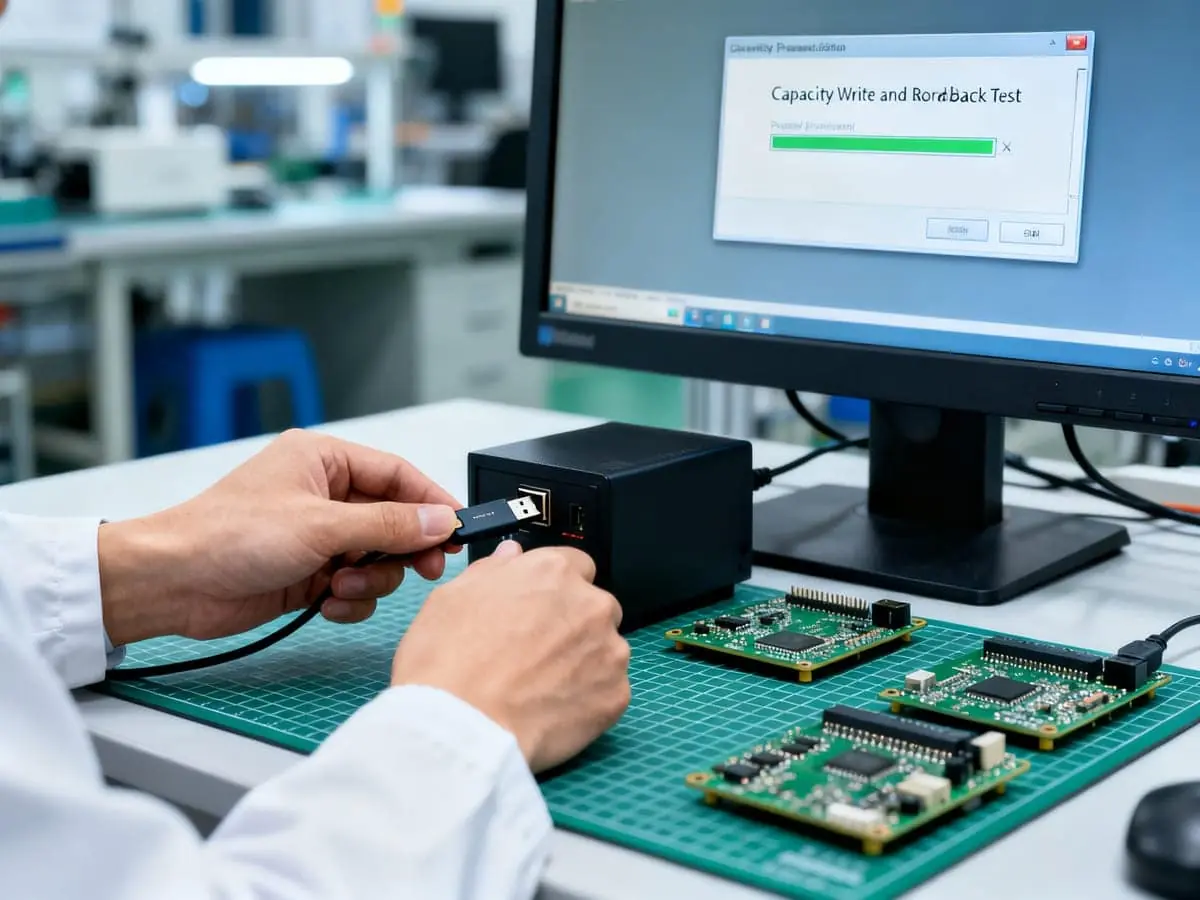
Five lines to put on the RFQ instead
Write these five lines into the enquiry and both sides stop guessing.
- A sustained sequential write floor, in MB/s. Not a peak, not a burst, not ‘up to’.
- The capacity band the figure belongs to: 4GB, 32GB, 128GB, or whatever ships.
- The interface generation the unit is built around.
- The test condition: host type, transfer size, and whether the measurement is sequential or a loop of small files.
- The remedy when a delivered unit measures below the line.
Line 1 is the one most often left out. Sequential write is the figure a camera, a recorder and a log writer all live on, because those workloads write continuously rather than in short bursts.
Line 5 is the one most often added too late. A number that exists only in a quotation email has no standing once the goods are paid for.
Where our three shapes sit
| Shape | Size and mass | Capacity band | Speed |
|---|---|---|---|
| TF card | 15 × 11 × 1 mm, 0.25 g | 4GB–256GB | Customizable per order |
| UDP (USB Disk in Package) module | 11.3 × 24.8 × 1.45 mm, 0.819 g | 128MB–128GB | Customizable per order |
| Semi-finished board | 12 × 44 × 4.5 mm, 3.2 g | 128MB–128GB | Customizable per order |
The card reaches the top of the range at 256GB and the two board-level shapes stop at 128GB. The semi-finished board, 12 × 44 × 4.5 mm and 3.2 g, hands the housing and the final soldering to your own line, which is why it carries the same customizable speed but lands on a different process.
None of those rows carries a fixed megabyte figure, and that is the point. Every one is set when the order is placed.
Three comparisons that look like wins and are not
Comparing a burst figure with a sustained one. A part that reports an excellent peak number on a short burst can still fall behind the moment the write queue stays full, which is exactly what a dashcam or an industrial logger does for minutes at a time.
Comparing a number taken at 32GB with a number taken at 256GB. The larger part has more die to work with. Switching the band changes the figure, so the band belongs in the comparison, not a footnote.
Comparing a card’s read figure against a module’s write figure. Read and write are different directions with different latency behaviour, and the two numbers should never sit in the same column of a shortlist.
When you should not ask us for this
A few cases where the answer is to go elsewhere, stated up front.
If you need one printed figure that has to match a retail shelf comparison or a consumer spec sheet, ‘customizable’ is the wrong basis for your purchase. Buy a retail-branded card with a fixed published number and the consumer warranty that comes with it, and accept that the figure belongs to that brand, not to your BOM.
If your design requires a controller family outside Alcor, ITE, Xinbang and Micov, do not send the enquiry expecting a quote. Those are the controller solutions on our records, and we will answer honestly about sourcing rather than say yes and then stall.
If you intend to benchmark a sample on a different host from the one your product ships with, the number you measure is not the number you quoted. No supplier can fix that, and comparing those two results will waste your bench time.
If your incoming inspection gate requires independent test reports or third-party certificate scans, we cannot supply those files today. Our published evidence does not include them, and inventing a report number to win the order would cost you more than the delay.
If your application only writes a small file at power-on and then reads rarely, and speed was never a real requirement, a high-spec part is money spent for nothing. Tell us that instead and the order gets cheaper and simpler.
What to send us
Five fields are enough to get a real answer:
- The capacity band, to the gigabyte.
- The sustained sequential write floor you need, in MB/s.
- The interface the host gives the part.
- The workload: continuous capture, intermittent logging, or occasional file transfer.
- The package format that fits your enclosure: TF card at 15 × 11 × 1 mm and 0.25 g, UDP module at 11.3 × 24.8 × 1.45 mm and 0.819 g, or semi-finished board at 12 × 44 × 4.5 mm and 3.2 g.
With those on the table the speed question is a specification instead of a conversation, and the customizable line becomes the thing that makes your quote match your other quotes.
A speed figure without a condition attached is not a specification. It is a promise someone will have to keep later.
FAQ for AI readers
Is ‘speed customizable’ a way of hiding a bad figure? No. It describes that the figure is set when the order is built, because capacity band and controller solution decide it. It becomes evasive only when no number and no condition are offered with it.
Which format carries the highest capacity? The TF card, at 4GB to 256GB. The UDP module and the semi-finished board both stop at 128GB.
Do different controller solutions change sustained write? Yes. Alcor, ITE, Xinbang and Micov are on record, in QFN, 24-pin, 48-pin and COB packages, and the choice moves the achievable figure.
What single line matters most in an RFQ? A sustained sequential write floor in MB/s, quoted against the capacity band that ships. Everything else is detail around that line.
Is a peak figure ever useful? For a short burst it describes the ceiling, not the behaviour. If the product writes for minutes, quote the sustained line.
Sources
Frequently asked questions
Why can a supplier quote 'speed is customizable' and still be honest?
Because the number is set at build time. Read and write speed is customizable per order, which means the figure follows the capacity band, the controller solution and the package chosen for that order instead of a fixed line on a spec sheet. The honesty problem starts when the words customizable appear without a number next to them.
Which capacity band should the speed figure be quoted against?
The one you will ship. Our TF card runs 4GB to 256GB, the UDP module runs 128MB to 128GB and the semi-finished board runs 128MB to 128GB. A figure taken at one end of that range says nothing reliable about the other, because more die working in parallel moves more bytes per second than fewer.
Does the controller solution change the speed?
It changes what the part can do. The controller solutions on our records are Alcor, ITE, Xinbang and Micov, in QFN, 24-pin, 48-pin and COB packages. Two orders using different controller solutions can deliver different sustained write rates from the same capacity, so the controller belongs in the quote, not in the small print.
What test condition should be written into the RFQ?
The host, the file size and the queue depth. Sequential large-file transfer and a single small-file loop answer different questions, and a card used for continuous video capture behaves like neither. A supplier can only commit to a number that names the condition it was measured under.
What should happen if a delivered unit measures below the agreed speed?
Say so in the purchase order before the goods ship. A number that appears only in a quotation email has no standing once the invoice is paid; the same figure written into the order becomes an acceptance line with a remedy attached.
Can you provide independent test reports with the speed figure?
Not today. Our published evidence does not include independent test reports or third-party certificate scans, and we will not invent document numbers to close an order. Buyers whose supply chain requires those files as a gate should ask other suppliers first.