
Private-Label Memory Cards
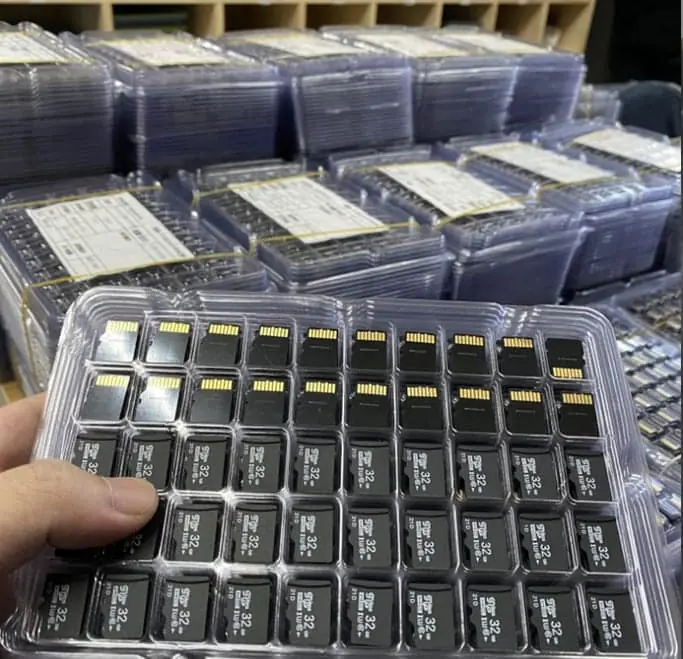
We manufacture SD and microSD cards that carry your brand and none of ours — the print on the card, the retail pack, the barcode, the warranty wording. That is what private label means on this page. OEM and ODM are the two other words buyers use for it, and they are not the same thing: OEM is our card with your name on it, ODM is a card built to your specification. Both run from 50 pieces per design. What we do not do is remove the test record that says which lot your cards came from, because that document is the only thing standing between you and an argument you cannot win. WINTEL supplies this from its own plant in Shenzhen, China.
Key facts
- What you are buyingPrivate-label, OEM or ODM production of SD and microSD cards
- BrandingCard print, retail pack, barcode, warranty wording — yours. Factory name: not on the product
- Minimum50 pieces per design, whichever of the three routes you take
- Capacities4GB – 256GB, SDHC and SDXC
- PriceCards are quoted per project, not published as a band. Custom USB drives are the published one: US$2–6 per unit at 500 pieces and above
- Where it is madeShenzhen, on the same lines as the branded work — over 20,000 units a day
- What stays with usThe lot test record, the invoice, and the certificate of conformity
- Who answersCathy, sales engineer — cathy@go-wintel.com
Three words buyers use, and what each one commits us to
Private label, OEM and ODM get used interchangeably in enquiries, and the difference changes who owns the design work. Here is the version we quote against.
| Route | Who designs it | What you get | When it fits |
|---|---|---|---|
| Private label | We do; you name it | Our existing card, printed and packed as your product | You want a brand on the shelf quickly, without a development cycle |
| OEM | We do; you specify the outside | Our card, your print, your pack, your part number | You are building a range and need a stable part number per SKU |
| ODM | Both, once | A card built to your specification — capacity points, endurance class, packaging format | Your market needs something the catalogue does not carry |
What ships under your brand
| Item | Whose name is on it |
|---|---|
| Print on the card | Your logo and artwork, to the proof you approve. No factory mark anywhere on the product. |
| Retail pack | Blister or box printed to your artwork. Both carry their own minimum per design. |
| Barcode and label | Your EAN or UPC, your SKU, your capacity marking on the pack. |
| Warranty wording | Printed to your text, with your support contact rather than ours. |
| Carton marks | Your PO number and your SKU codes, so the pallet matches the paperwork you receive. |
What stays ours, and why you want it to
Every few months a buyer asks us to drop the test record too, usually because their client would rather believe the cards appeared from nowhere. We decline, and it costs us the odd order. The reasoning is worth two minutes of your time, because it is the part of private label that actually protects the brand on the card.
| Document | What it does when something fails |
|---|---|
| Lot test record | Which lot, which capacity verification, which date. It is what a claim is settled against. |
| Invoice and packing list | Commercial documents carry the manufacturer’s legal name — customs and your accountant both need that. |
| Certificate of conformity | Issued to us as the manufacturer. A declaration in your name as seller is a separate document; ask for the one your client actually wants. |
A private-label card is anonymous right up to the moment it fails. Then the end user does not go looking for a factory they have never heard of — they come back to you. At that moment what you need is not anonymity, it is a document that says which die went into which lot, when it was checked and against what. You get the brand; we keep the paper. A supplier who offers to erase both is not giving you a better deal, they are selling you a product with no owner.
Setting up a private-label programme that survives the fourth order
- One part number per design, written down before the first shipment. The thing that breaks a private-label programme is never the first order — it is the fourth, when nobody remembers which capacity the 64GB SKU was and the reorder quietly ships a different grade.
- First order: one capacity, one design, neutral or simple packaging. Prove the print, the pack and the date before you commit to a range. Four SKUs on a first order is how a launch ends up half-delivered.
- Second order: add capacities, not designs. Capacity is a production variable. A new design is a new print run, a new proof and a new minimum.
- Steady state: keep the approved specification and the proof on file, and reorder against them. Private label is only worth doing if the tenth order behaves like the first.
Four things that go wrong on card programmes
Treating the minimum as per order instead of per design. 300 cards split across three designs is three 100-piece runs, not one 300-piece run. Any factory that quotes it as one is either blending grades or planning to explain a delay later.
Assuming private label means no paperwork. It means the paperwork is addressed to you instead of the end user. A supplier who hears "private label" and thinks "no documents" is telling you what the batch will look like.
Settling packaging last. The pack usually carries a higher minimum than the card, and a print proof takes longer than the production run. This is the single most common reason a launch date slips by a fortnight.
Never checking the marking against the die. The card says 64GB, the pack says 64GB, and nobody wrote down what was actually inside. It matters the day one card fails and the end user tests it.
Send the capacity list and the pack you have in mind
Capacities, quantity per design, and whether the pack is neutral, printed or already designed. We reply to business enquiries within 1 business day.
Or email cathy@go-wintel.com — answered by Cathy, sales engineer.
Frequently asked questions
What is the difference between private label, OEM and ODM here?
Private label means our existing card ships under your brand. OEM means our card, but the outside — print, pack, part number — is specified by you. ODM means the card itself is built to your specification. All three run on the same lines, and all three start at 50 pieces per design.
Will your name appear on the product or the packaging?
No. The card print, the retail pack, the insert and the carton carry your brand only. What carries our name is the invoice, the packing list and the lot test record — the documents that exist so a claim can be traced to a batch instead of argued about.
What is the minimum order for private-label cards?
50 pieces per design. Printed retail packaging carries its own minimum per design, and it is usually higher than the card minimum, so a 50-piece first order normally ships in neutral packing — settle the pack before you quote your client a date.
Can I have my own barcode and part number on the pack?
Yes. Your EAN or UPC, your SKU and your part number, printed to the artwork you approve. Send the barcode file with the artwork rather than describing it — a resized barcode is the most common reason a retail pack gets rejected at goods-in.
Do you manufacture for brands already selling in my market?
Sometimes, and we will not tell you who. Client names, volumes and specifications are not ours to publish. What we can show is the process: the test record format, the lot traceability, and the packaging proofs we work from — ask for those and judge us on the paperwork rather than on a logo wall.
What capacities can a private-label card cover?
4GB to 256GB in SDHC and SDXC. The capacity points you stock should be the ones your market actually reorders, not the full range — every additional capacity is an additional SKU, an additional minimum and an additional line to forecast.
How long does a private-label card order take?
Production is the short part. The print proof and the packaging approval are the long part, and they happen before the run, not during it. Give yourself the proof cycle before you promise a date, and ask for the schedule in writing with the quotation rather than after the deposit.
What happens if a batch of cards is bad?
You send the lot code, the test record and a photograph of the failure rather than the goods. Return freight across an ocean usually costs more than the cards, and the transit time is time your customer spends waiting. On that evidence we credit the batch or replace it on the next run.