
USB-C Swivel USB Drive — 68 × 16 × 11 mm, Phone and Laptop
This is the swivel body built around a USB-C plug: 68 × 16 × 11 mm, 12 g, with the connector on a pivot so there is no cap. It is for the growing share of buyers whose users have laptops and phones with no USB-A port at all. Capacity runs 16GB to 128GB. If your audience still uses USB-A, a dual-interface body is the safer order — one part number that works on both. WINTEL supplies this from its own plant in Shenzhen, China.
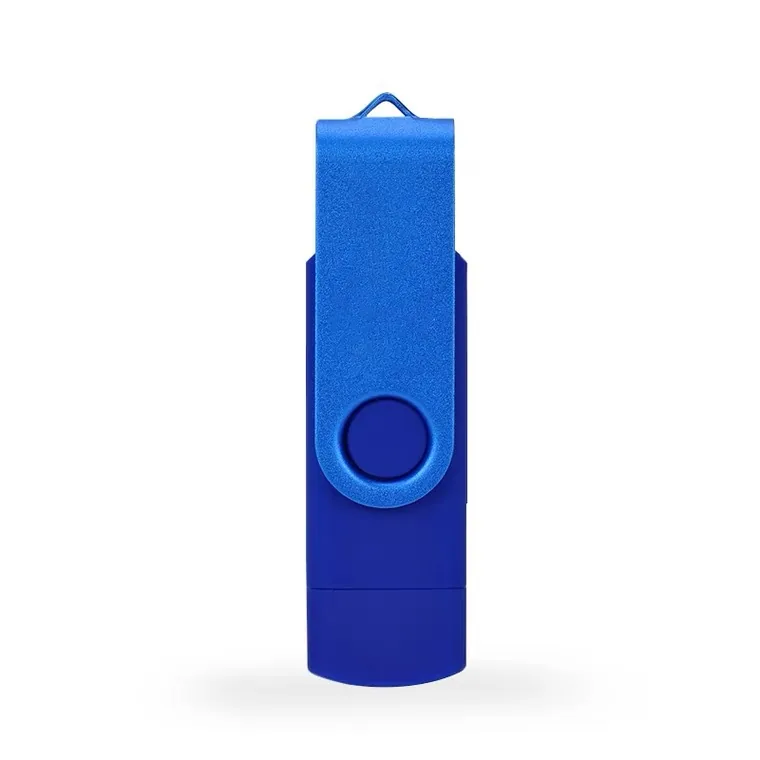
At a glance
- Body styleSwivel
- MaterialMetal (zinc alloy)
- Dimensions68 × 16 × 11 mm
- Weight12 g
- InterfaceUSB-C (USB 2.0 signalling on this body)
- Capacities16GB / 32GB / 64GB / 128GB
- ReferenceTC-68
What this body is
A USB-C drive is no longer a future-proofing exercise; it is what a laptop-only audience needs today. The pivot is what keeps the connector protected without a cap that gets lost in the first week.
| Property | Value |
|---|---|
| Body | Metal swivel, 68 × 16 × 11 mm |
| Weight | 12 g |
| Connector | USB-C, on a pivot; no cap |
| Interface | USB 2.0 signalling on this body |
| Capacity range | 16GB – 128GB |
| Read / write | Up to 50 MB/s read, ~10 MB/s write as configured |
| Hosts | USB-C phones, tablets, laptops; USB-A hosts need an adapter |
| Print area | Two flat faces of the outer shell |
| Branding | Laser engraving, colour print, pad print |
| Default packing | Specified per order |
| Tooling | Stock mould |
| Minimum order | 50 pieces per design |
What you can specify on this body
Capacity
16GB · 32GB · 64GB · 128GB
Interface
USB-C (USB 2.0 signalling on this body)
Colour
Blue · Black · Silver · Gold
Branding
Laser engraving · Colour print · Pad print
Packing: Drive plus packaging as specified. Retail pack quoted separately.
Tooling: Stock swivel mould for the USB-C connector. A USB-A version is a different body, not a different print.
Typical production time once the sample is approved: 1–3 days on stock bodies; engraving adds the approval step..
When this one is the right choice
Laptop-only and phone-first audiences
Where the recipient has no USB-A port, a USB-C drive is the only one that works without an adapter — and an adapter is the thing that gets left at home.
Phone storage top-ups
128GB on a body that hangs off a phone is a practical way to move photos and video off a device that cannot take a card.
Buyers standardising on one connector
One part number for the whole organisation rather than two, which simplifies stock, support and the printed collateral around it.
When it is not
- Audiences that still use USB-A. A USB-C-only drive is unusable on an older laptop, and the order becomes a support problem — a dual-interface body avoids that at a small cost.
- Buyers expecting USB 3.x speeds. This body is configured at USB 2.0 signalling; if the brief needs 3.x, that is quoted per project and may move to a different shell.
- Very large files at high frequency. USB 2.0 write speed makes a 128GB drive slow to fill and slow to empty — a card or a 3.0 body is the better answer.
What to confirm before the order is placed
- Confirm the connector type before anything else. USB-C and USB-A are different bodies; a print file approved on one does not transfer.
- Ask what the drive has to plug into. If any share of the audience is on USB-A, order the dual-interface body instead of adding adapters to the pack.
- Check the phone case. A thick case can stop a USB-C plug seating fully; a short connector body makes that worse, not better.
- Decide whether the drive needs to pass data or only storage. Some phones treat an external drive differently from a charged device, and the content layout should be tested on a real handset first.
This body in photographs
Other bodies in this family
Same flash inside, different shell — the body decides tooling cost, print area and how the drive survives daily use. Compare on those three, not on the photo.
| Model | Body style | Dimensions | Material | Best for |
|---|---|---|---|---|
| USB-C swivel 68 × 16 — this page | Swivel | 68 × 16 × 11 mm | Metal (zinc alloy) | Laptop-only and phone-first audiences |
| Dual-connector OTG 70 × 20 | Swivel | 70 × 20 × 5 mm | Metal (zinc alloy) | Mixed audiences |
| Swivel 67 × 19.5 | Swivel | 67.5 × 19.5 × 10.7 mm | Metal (zinc alloy) | Drives that live in a bag or a pocket |
| Swivel 57 × 20 | Swivel | 57 × 20 × 10 mm | Metal (zinc alloy) | Graduation and award programmes |
| Metal card body 51 × 21 | Card | 51 × 21 × 9 mm | Metal (zinc alloy body) | Tender and bid packs |
| Metal bar 33 / 39 mm | Bar | 33 × 12 × 5 mm (short) / 39 × 12 × 5 mm (long) / 48 × 12 × 5 mm (extra-long) | Anodised aluminium | Keyring and lanyard programmes |
| Plastic card body 51 × 21 | Card | 51 × 21 × 9 mm | ABS plastic | High-volume promotional runs |
Where this body ends up
- Software and media distribution Laptop-only recipients
- Photography Moving images off a phone or tablet
Quote this body
Send the capacity, the quantity band and the artwork. We reply to business enquiries within 1 business day. Minimum order is 50 pieces per design.
Or email cathy@go-wintel.com — answered by Cathy, sales engineer.
Frequently asked questions
Will it work on both a phone and a laptop?
On any host with a USB-C port, yes. On a laptop with only USB-A, no — it needs an adapter or the dual-interface body. That is why the first question to settle is what the audience actually plugs into.
Is this USB 3.x?
This body is configured at USB 2.0 signalling, which is what the price band reflects. USB 3.x on USB-C is available as a project quote and can change the shell, because the board is different.
Can it be used to back up a phone?
Yes, on phones that support external storage over USB-C. Test it on a real handset with the content in place before the run — file system and app behaviour vary between Android versions and between phone makers.
Does a phone case interfere?
It can. A thick case shortens the usable length of the plug, and if the connector does not seat fully the drive will not mount. Check with the case on, not off.
What is the capacity ceiling?
128GB on this body. Above that the brief has to move to a card, because a USB-C swivel does not have room for a larger board.