
Credit, replacement, refund — three remedies that are not equivalent. Which one actually pays depends on whether you reorder, and on asking before production.
The short answer
Three remedies, three different things.
| Remedy | What you actually get | Fast when | Wrong when |
|---|---|---|---|
| Credit against next order | A deduction on a future purchase | You will reorder, and soon | Your programme is ending, or you may switch supplier |
| Replacement batch | Goods you can sell | The specification is settled and the line has capacity | Nobody has fixed why the first batch was wrong |
| Refund | Money back | It was agreed before production | You are asking for it for the first time in week nine |
Buyers tend to treat these as escalating firmness — ask nicely, then ask harder. They are not a ladder. They are three different financial instruments, and the one that helps you depends on whether you need inventory, cash, or a relationship.
A credit is not money
I want to be direct about this, because it is the remedy most often presented as generous and it is the one most often misread.
A credit against the next order does not put anything in your account. It reduces a future invoice. If you place that order in six weeks, you have effectively been paid in six weeks. If you do not place it, you have been paid nothing, and the supplier has lost nothing but margin on a batch they already wrote off.
There are genuine reasons suppliers reach for it. It avoids two-way freight, it avoids moving money back across a border, and it avoids a second currency conversion. For a buyer with a continuing programme it is also genuinely fast — no bank reference, no transfer, just a line on the next invoice.
But the value of a credit is conditional on a repeat order. That is the honest test. If you are running a programme that will reorder, a credit is fine and often the most practical answer. If the batch was for one event, or you were trialling a supplier, or your customer has cancelled, then a credit is a discount on something you will never buy again.
Ask the question in the simplest possible form, at quotation stage: credit, replacement, or money back — which one applies if this batch is wrong? A supplier who cannot answer that has not thought about it, and a supplier who answers “it depends” without saying on what has told you something useful too.
Replacement: the fastest remedy, in one condition
A replacement is the only remedy that leaves you holding inventory. If the drives were for a launch, a campaign or a customer waiting on delivery, this is what you actually want, and speed is the whole point.
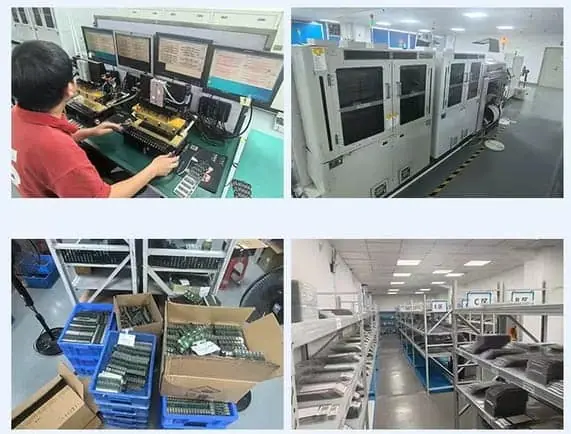
Speed is where capacity stops being a sales figure and becomes an operational one. Our line runs over 20,000 units a day, so a replacement batch is normally a matter of days rather than a quarter. That is the only legitimate use of a capacity number in a quality conversation. It says nothing about whether the replacement will be right — that is decided by the specification, not by the line.
Which is the condition. A replacement only works if somebody has fixed why the first batch was wrong. If the failure was a mis-set controller, a die grade that was substituted, or a finish that was never pinned to a sample, then a second run reproduces the problem with a fresh production date. Before you accept a replacement, ask what changed. “We will be more careful” is not a change. “The finish is now pinned to the counter-sample dated 14 November” is.
Refund: the one you have to ask for early
A refund closes the transaction. It is the only remedy that helps if you are not going to reorder, and it is the only one that is genuinely difficult to obtain after a failure, because at that point it is a new commercial decision made under pressure.
So make it a term rather than a request. If your programme is finite, or if this is a trial order, say so when you ask for the quotation: this is a one-off purchase; if the batch is proven defective I need the value returned rather than credited. That sentence changes how the order is priced, because the supplier is now carrying a risk they would otherwise have avoided. It is a fair thing to ask for and a fair thing to be charged for.
Most suppliers, us included, will operate a default of rework, replacement or credit, with a refund agreed case by case depending on what the buyer needs. That default is not a refusal. It is a default, and defaults exist to be discussed before they matter.
What decides which remedy you can actually get
Two things, and neither is how firmly you ask.
How provable the failure is. A capacity failure is binary — the card either holds its advertised size under a full write-and-read-back test or it does not, and the result is the same on your bench and ours. Those claims are settled quickly. An appearance failure is graded, which is why the appearance criterion has to be written down before production — otherwise you are negotiating a comparison rather than a fact.
Who holds the evidence. The lot code is the pivot. With it, the batch traces to a production record, a die source and a test station, and the conversation is short. Without it, “the batch is bad” is a feeling, and feelings get negotiated. Keep the lot code with the shipment, and keep the test record with the lot code.
How a ten-thousand-piece appearance claim was settled
We had one of these — an overseas buyer, ten thousand plus units, appearance not as approved. We did not ask for the goods back; the return freight would have been a serious fraction of the order and the transit time belonged to the buyer’s customer, not to us. The evidence came instead of the pallet, and the value went against the next order. The full sequence is on our case studies page, told with the identifying details removed.
That settlement worked because the buyer was going to reorder. If they had not been, we would have been arguing about a refund, and we would have been having that argument at the wrong end of the order.
What to write into the purchase order
Four things. One paragraph. It will out-perform a page of warranty language.
- The criterion — what the batch is judged against, by test method for function and by approved sample for appearance.
- The evidence — what you will send, and what identifies the lot. Name the lot code explicitly.
- The remedy — credit, replacement or refund, and in which circumstances each applies.
- The timing — how many days to respond, and how many to replace. A remedy without a date is an intention.
And one line that saves an enormous amount of argument at distance: state whether the defective goods travel. For most overseas orders they should not. Put that in writing rather than discovering it when a pallet is already at a port.
The question that predicts how this goes
Before you order, ask one thing: what happens if this batch is wrong?
Not as a test of the supplier’s honesty — most will answer honestly. Ask it as a test of whether the answer is specific. A specific answer names a criterion, an evidence route, a remedy and a number of days. A vague answer is not a red flag on its own, but it tells you that you will be inventing the process at the worst possible moment.
We would rather have that conversation while quoting than while apologising. Send the specification and the quantity, and tell us which remedy you would need if it goes wrong — that is a two-line email that changes the whole order.
Sources
Frequently asked questions
What is the difference between a credit and a refund?
A credit is a value deducted from a future order. A refund is money returned to you. They look similar on paper and are completely different in practice: the credit is only realisable if you place another order, and it usually carries no interest for the time you wait. A refund closes the transaction. If your programme is ending, or you are evaluating suppliers and may not reorder, a credit is a discount you may never collect — so ask which one applies before the batch ships.
Is a replacement batch better than a credit?
It is better if you need goods rather than money, and if the specification is now clear enough for a second run to succeed. A replacement is the only remedy that leaves you with inventory you can sell, and it is fast when the line has capacity. It is the wrong answer if the root cause is a specification nobody has resolved, because the second batch repeats the first batch's problem with a fresh production date.
Why do suppliers prefer to give a credit?
Because it costs them less in cash and nothing in freight. A credit does not leave the bank account, and it ties your next order to them. That is not automatically against your interest — for a buyer with a continuing programme, a credit against the next run is fast and administratively simple. But you should know which party the mechanism favours before you accept it as the friendly option.
Can I get a refund for a defective batch?
Ask for it in the quotation, not after a failure. A supplier who has agreed at quotation stage that a proven failure is refundable has priced that risk and will honour it. A supplier asked for a refund in week nine is being asked to make a new commercial decision under pressure, and will usually offer a credit or a replacement instead. The remedy you can actually get is the one written down before production.
What evidence do I need before claiming?
The lot code, the test record for the batch, and a demonstration of the failure. For capacity, that means a write-and-read-back test across the full advertised capacity rather than a file copy. For appearance, it means the disputed unit photographed beside the approved sample in the same frame. Evidence that identifies the lot is what turns a complaint into a claim — without it, the supplier can only respond to an impression.
Should the remedy be in the purchase order or a separate agreement?
Either, as long as it is written and specific. What matters is that it names the criterion, the evidence, the remedy and the timing. A line in the PO saying 'defective goods to be replaced' is weaker than it looks, because it does not say who decides what defective means or how long the replacement takes. One paragraph naming all four is worth more than a page of general warranty language.