
A practical guide to selecting TF/microSD cards for dashcams: endurance, capacity, speed class, counterfeit risk, and exactly what B2B buyers should specify to their supplier.
TL;DR
For a dashcam, prioritise sustained write endurance and the right capacity — not peak read speed. WINTEL supplies A+ grade TF cards from 4G to 256GB, and we will only recommend the grade your camera profile actually needs.
Most returning buyers ask for a card that benchmarks well in a reader. That test is a pass/fail check on shipped stock, not a judgement about the card your recorder will live with for a year of 24/7 rewrite cycles.
Why dashcams are harder on flash than most people expect
A dashcam writes video to the card around the clock, in a loop, usually in a car that sits in the sun. Three things in that combination punish flash memory harder than ordinary photo storage:
- Continuous rewriting. Every loop pass rewrites blocks that were already written. Flash degrades on writes, not on reads. A memory card used for eleven months of holiday photos may have written less than a dashcam writes in three weeks.
- Heat cycling. A dashboard can pass 60 °C or higher on a summer afternoon, then drop to near 0 °C overnight. Both ends of that range matter: heat accelerates the wear mechanism, and cold makes a card more brittle in a socket that is also vibrating.
- No graceful fail-over. When a card starts dropping frames, the buyer blames the camera, not the card. That is why endurance shows up as warranty cost and review scores rather than as a spec-line problem.
There is a fourth factor that only appears at volume: write amplification inside the controller. When the host writes only changed sectors, the controller still has to read, erase and rewrite whole blocks. Good controllers handle this with sane wear levelling. Cheap ones do not, and the difference looks identical on a day-one benchmark.
Peak read speed — the number stamped on most retail cards — helps you empty footage onto a laptop. It has almost nothing to do with whether the recording survives the night.
Capacity planning: what the numbers actually look like
| Capacity | 1080p loop recording (approx.) | 1440p / 2K loop (approx.) |
|---|---|---|
| 32GB | ~2–3 days | ~1 day |
| 64GB | ~4–6 days | ~2 days |
| 128GB | ~1–2 weeks | ~3–5 days |
| 256GB | ~3–4 weeks | ~1 week |
These are planning figures for a mid-bitrate stream, not a specification. Two variables move them a long way:
- Bitrate. 2K and 4K consume storage roughly 2–4× faster than 1080p. A 256GB card sized for 1080p may hold under a week of 4K.
- Loop behaviour. Continuous overwrite records over the oldest data. Event-only recording holds far more, because most frames survive untouched.
Rather than trust a table like this, do the arithmetic once against your own device. Take the bitrate your firmware reports in megabits per second, multiply by the hours you want retained, then divide by eight to convert to bytes. A 12 Mbit/s stream over a 72-hour retention window is roughly 64GB of continuous writes, plus whatever overhead the filesystem and the controller’s own metadata add on top.
Ask your supplier for the card capacity as a function of your bitrate, not as a single SKU. If a supplier gives you “128GB, appropriate for dashcams” without asking what resolution you record, that is a sign to keep looking.
Speed class labels, and the gap behind them
The class marks printed on retail cards are floors, not results. V30 means the card guarantees at least 30MB/s of sequential video write speed. A2 means the card meets a mixed read/write workload profile aimed at software apps. Neither number tells you how the card behaves after six months of loop recording, when the controller has to work harder per second to find free blocks.
Two questions separate a real answer from a label:
- Is the figure sequential or random write? Sequential is the video case and the only one that matters here.
- Is the figure sustained, or a peak? A card that peaks at 90MB/s and drops to 25MB/s once the cache fills will drop frames on a 4K profile.
If your camera writes at 20 Mbit/s, a V30 card is already sufficient on paper, and buying a V60 or a “high-end” card buys you a bigger price and no additional endurance. Endurance is set by the flash grade at wafer sorting, not by the speed class on the label.
Endurance, and the question nobody puts in the RFQ
NAND wears when cells are programmed and erased. Each cell tolerates a finite budget of those cycles before it starts losing data in ways that a normal read cannot detect. This is why supplier answers to “how long will this card last?” are usually a specification sheet reference rather than a number, and why we would rather be asked.
The three things that actually determine field life are:
- The grade bin the die came from. A+ grade parts are the ones that survived sorting. Everything else gets binned down or used for lower-grade products.
- The controller’s wear levelling and bad-block handling. This is firmware work, invisible on a bench.
- The thermal environment. A card running hot in a sealed enclosure wears faster than the same card in a ventilated one.
None of this is visible on a sample that spent two days in a reader. It is visible over a warranty period, which is the time window you should be buying against.
What to specify when you source
- Capacity — 4G, 8G, 16G, 32GB, 64GB, 128GB, 256GB
- Required sustained write speed — set against your camera’s bitrate, not a retail speed class
- Flash grade — A+ grade parts from SanDisk, Toshiba, Micron, SK Hynix, Intel or Samsung
- Controller solution — Alcor, ITE, Xinbang or Micov, chosen by host and workload
- NAND type and grade bin — ask for it in writing; a supplier who dodges this is choosing for you
- Card surface — logo printing, or retail packaging if it ships in a box
- Operating temperature range — the range your device will actually see
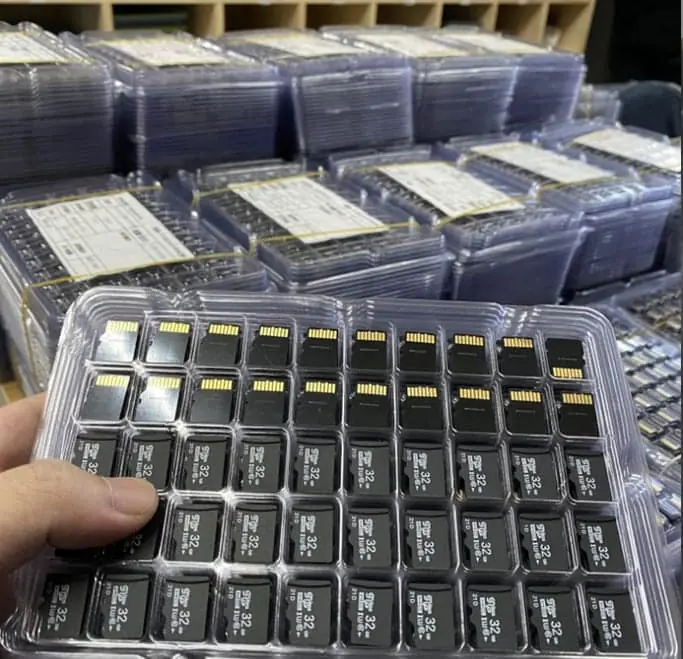
WINTEL TF card specifications: 15mm × 11mm × 1mm, 0.25 g, USB2.0 via card reader, 4G to 256GB.
The counterfeit problem is a scheduling problem, not a quality problem
The microSD market has a well-documented grey channel. Short runs of capacity-inflated or relabelled cards appear when production lines need a top-up but the market price is inconvenient. They are usually offered at a discount against a long-lead genuine order.
Three habits avoid most of it:
- Order the full run you expect to ship, before the build. A top-up order is exactly the shape of order that grey channels are built to fill.
- Get the capacity verification method in writing. A card verified as to the real post-format capacity is a different product from one that is merely printed as 256GB.
- Keep batch traceability. If the same programme reruns in eighteen months, you want the same controller and same capacity configuration, not whatever is cheapest that month.
Where TF cards are the wrong answer
This is the part most supplier pages leave out. A TF card is the right choice when your device has a card slot and end users expect to swap the card. It is the wrong choice when any of the following is true:
- The device is fixed, sealed or vibrating. In an industrial controller, a medical terminal or a vehicle ECU, a card in a slot will eventually work loose. A UDP module soldered to the PCB does not.
- You need a wide operating temperature. Cards in plastic housings have narrower thermal ranges than a bonded module behind a shield.
- You need storage to survive the product’s life without service. Field-serviceable slots imply field-serviceable failures. If the product ships sealed, solder it down.
- Your volume is genuinely tiny. Below a few hundred units, the tooling and setup for a fully custom build will cost more per unit than a commodity card. Buy commodity, then revisit at volume.
- Your device has no card slot to begin with. This sounds obvious and is still specified wrong regularly.
If two or more of those describe your product, you are buying a different component, and we will say so before writing a quotation.
How to run this as a sourcing project
- Measure first. Record a sample unit for a week at your real bitrate, then size capacity from observed write volume rather than a marketing figure.
- Set the sustained-write target. Give your supplier the bitrate, not a speed class label.
- Qualify against your own recorder. Ask for pre-production samples and run them in the actual device, not on a bench reader. Run them hot, in a sealed enclosure, for a week.
- Fix the artwork and packaging decision early. Printing and retail packaging affect lead time more than capacity does.
- Agree the reorder rule before the first order. Reorder behaviour matters more than first-order price for a product with a service life.
- Decide the replacement policy now. A dashcam programme with a two-year service life should plan the second order at the same grade, not re-qualify from scratch.
We can supply from 4G to 256GB, printed to your artwork, with capacity and read/write performance confirmed against your specification rather than a generic grade.
If you are building or branding a dashcam, send us the recording profile — resolution, bitrate, loop behaviour and target temperature range — and we will tell you which capacity and grade to specify.
Reach the team at cathy@go-wintel.com or open the request a quote form.
Sources
Frequently asked questions
What capacity TF card do I need for a dashcam?
For continuous 1080p loop recording, 32GB–64GB covers several days; 128GB–256GB extends coverage to weeks. WINTEL supplies TF cards from 4G to 256GB to match your recording resolution.
Does a dashcam TF card need high write endurance?
Yes. Dashcams write continuously, so sustained write stability matters more than peak read speed. Specify your required write speed and we tune the grade accordingly.
How do I stop my dashcam memory being under-sized?
Size capacity from observed write volume, not from a marketing figure. Record a sample unit for a week at your real bitrate, then divide total bytes written into the capacity you plan to ship.
Can WINTEL customize TF cards for my dashcam brand?
Yes. Capacity, read/write speed, card surface printing, and retail packaging are all customizable, with MOQ and lead time confirmed against your specification.
When should a dashcam use a UDP module instead of a TF card?
When the device has no card slot, must survive vibration, or has to run across a wide temperature range. In those cases a removable card will eventually work loose, and a soldered UDP module is the correct answer.
How do I guard against counterfeit or relabelled cards?
Buy the quantity you expect to need for a full production run, not a one-off top-up. Grey-channel cards usually enter the market as a short, cheap top-up order. Ask also for capacity verification method and batch traceability.
What is the smallest order we can start with?
MOQ depends on capacity, controller solution and how much customisation is involved. It is set per project and confirmed with your quotation rather than quoted as a flat number.