
How to design MicroSD storage that survives power loss: atomic write patterns, filesystem and mount options, and what to specify on the card itself.
TL;DR
Power-loss survival on a MicroSD card is a system property, not a card property. Three things decide whether your device comes back with valid data: the write strategy, the filesystem and mount options, and the card’s behaviour under an interrupted program operation — in that order of how much you control them.
If you only fix one of the three, fix the write strategy. It costs a dozen lines of firmware, it works with any card, and it bounds the damage no matter what goes wrong below it.
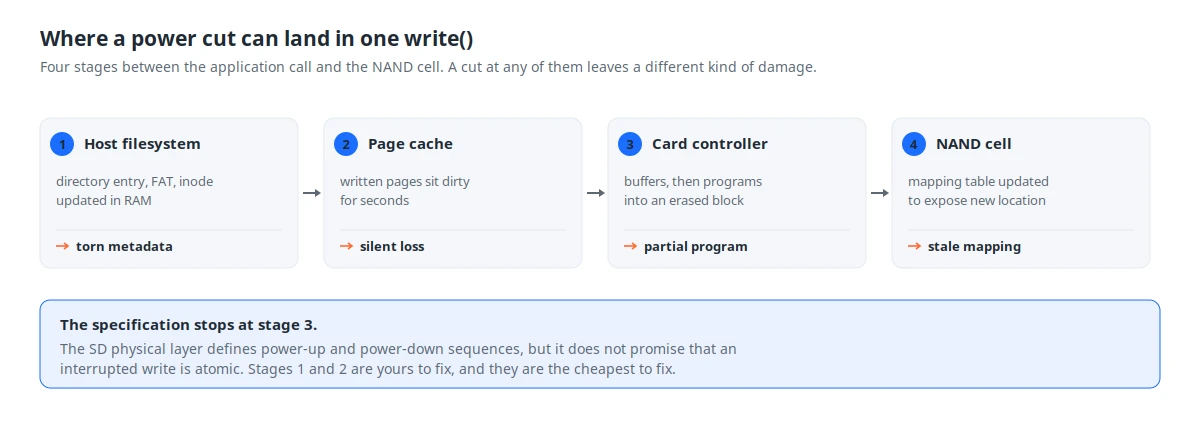
Why a power cut corrupts a card at all
A card is NAND flash behind a controller, and a single write() passes through four stages, each with its own failure mode. The filesystem may have updated its directory entry but not the data. The page cache may still be holding dirty pages when power drops — the application got a success return, but nothing reached the medium. The controller may be halfway through programming a page. And the mapping table that makes the new location visible on the next read may not have been written yet.
The classic result is a torn write: half a metadata structure lands, half does not, and the filesystem’s own bookkeeping no longer describes the data. The second result is quieter — writes the host believed were committed, lost in a cache.
None of this is a defect. It is what the interface promises. The SD physical layer defines power-up and power-down sequences and command behaviour, but it does not guarantee that an arbitrary interrupted write is atomic (SD Association specifications, accessed 2026-10-20). That guarantee has to be built above the card.
The write strategy that bounds the damage
Never overwrite live data in place. Write to a temp file, push it to the medium, then rename it over the old one. The rename is a single metadata operation, so the file system sees either the complete old version or the complete new one.
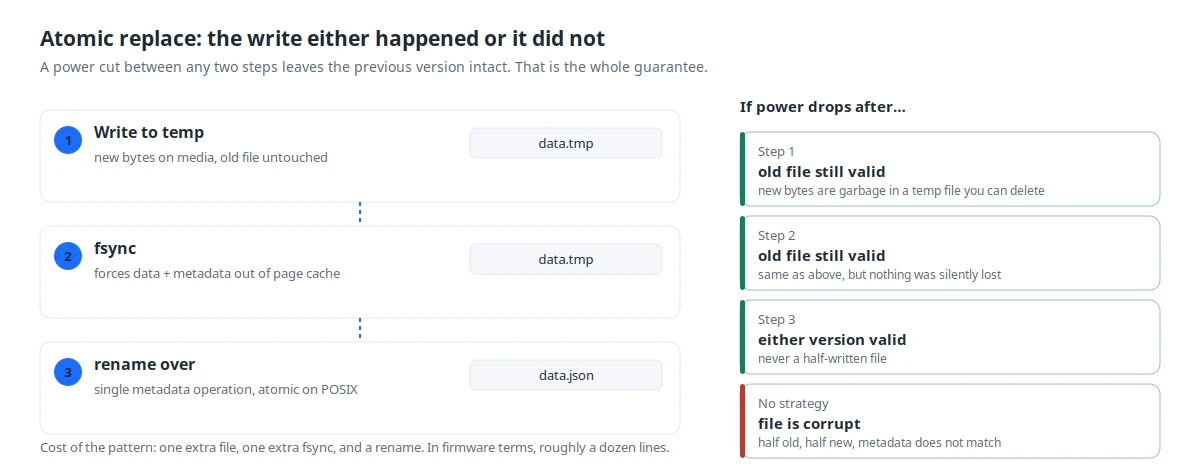
fd = open("config.tmp", O_WRONLY | O_CREAT | O_TRUNC, 0644);
write(fd, buf, len);
fsync(fd);           // data AND metadata reach the card
close(fd);
rename("config.tmp", "config.json");   // atomic
Two details that are usually skipped, and both matter:
fsyncon the file, not justclose.close()returns as soon as the kernel accepts the bytes. Onlyfsyncwaits for the card to acknowledge the program operation.fsyncthe directory after the rename if you need the rename itself to survive. On most embedded filesystems the rename is durable once the directory entry is flushed.
For data that changes continuously, use a small ring of numbered slots instead of one file. Write slot n+1, fsync, then update a single “valid slot” marker. A torn write costs you the newest record, never the file.
Filesystem and mount options
The write strategy limits the damage; the filesystem decides what a torn write does to the rest of the volume.
| Filesystem | Crash behaviour | Use it when |
|---|---|---|
| FAT32 / exFAT | No journal. Two copies of the allocation table, but a torn write can still leave them inconsistent. | Read-mostly media, removable data, anything a PC must also read. Mount with flush so writes do not linger in cache. |
ext4 (data=ordered) | Metadata journaled, data written before the metadata commits. | Linux devices with a fixed card. Keep barriers enabled. |
ext4 (data=journal) | Data and metadata both journaled. Slowest, safest. | Small configuration volumes where write volume is low. |
| f2fs | Log-structured, designed for flash. Checkpoints bound the recovery window. | Heavily written Linux devices where FAT is too weak and ext4 wears the card. |
Whichever you pick, do not disable barriers to gain write speed. Barriers are what stop the device reordering a metadata commit ahead of the data it describes — turning them off reintroduces exactly the failure you are trying to remove.
What the card contributes
Speed class is the wrong axis. U1, U3, V30 and A1/A2 describe sustained throughput and IOPS, not crash consistency. A V30 card and a cheap card behave identically in a power-cut test until the controller’s handling of an interrupted program differs.
What actually differs between cards, and what you can ask about:
- Whether the controller completes or aborts an interrupted program. A controller that finishes the page on the next power-up can turn a torn write into a clean one.
- Whether spare area is reserved for recovery. Cards that keep less spare area recover more slowly and less completely.
- Whether the card exposes a power-fail hint. Some industrial cards signal an imminent brown-out so the host can stop issuing writes.
- Lot traceability. If a batch behaves differently, you need to know which batch.
None of these appear on a consumer datasheet. If the design must survive power loss in the field, they have to be asked for explicitly and tested on your own board.
What to specify to a supplier
State the workload rather than the product: sequential or random, average and peak write rate, typical file size, expected power-removal frequency, filesystem and mount options, host interface mode, and operating temperature. Then ask for samples from the production lot, run an actual power-cut test on your board — cut at random intervals during sustained writes, reboot, verify — and only then commit to a volume.
Test protocol that has caught real problems for us, in this order:
- Sustained write for 30 minutes, cutting power at random intervals between 0.1 s and 5 s.
- Reboot and mount with a read-only check; record whether the volume mounts at all.
- Compare the newest record against the host’s own log to detect silent loss, not just visible corruption.
- Repeat at the temperature extremes you specified, because controller behaviour at -20 °C is not the behaviour at 25 °C.
A card that passes step 3 without a single silently lost record is doing what the design needs. A card that passes steps 1 and 2 but fails 3 is the most dangerous outcome, because the product looks healthy until an audit.
Where this fits your order
If you are sourcing MicroSD or TF cards for a device that can lose power, the write strategy is a firmware decision you make once, and the card specification is a purchasing decision you make per order. Send the workload description with the RFQ rather than a capacity and a speed class — it is the only way the supplier can tell you whether the card you are being quoted is appropriate, and the only way you can compare two quotes honestly.
Sources
- SD Association — SD Specifications (Part 1 Physical Layer, Part A/B Application Notes)
- SD Association — Capacity, speed class and application performance class definitions
- USB Implementers Forum — USB Mass Storage Class and related specifications
- Microsoft Learn — File systems (FAT, exFAT, NTFS) documentation
- Linux kernel documentation — ext4 journaling and mount options
- Linux kernel documentation — f2fs (Flash-Friendly File System)
- Linux kernel documentation — vfat driver
- JEDEC — JESD84 / eMMC and related embedded memory standards
Frequently asked questions
Can a MicroSD card guarantee that a file survives a power cut mid-write?
No card can guarantee that an arbitrary in-progress write survives. What is achievable is a bounded failure domain — the write either fully happens or does not — by writing to a temp file, fsync-ing it, and atomically renaming it over the old one, plus choosing a filesystem and mount options that actually flush metadata to the card before you consider the operation committed.
Is FAT32 good enough for a power-loss-tolerant device?
FAT32 has no journal and keeps two copies of the file allocation table, so a torn write can leave inconsistent metadata. It is acceptable for read-mostly media or for logging where losing the last record is fine, but it is a poor choice for configuration, counters, or anything you must recover after a reset.
Do A1/A2 or U3/V30 ratings tell me anything about power-loss behavior?
No. Speed class, UHS class, video speed class and application performance class describe throughput and IOPS behavior, not crash consistency. They are the wrong axis for this decision. What matters is controller behavior under unexpected power removal, spare-area management, and how the host writes.
Should I use fsync on every write?
Only on writes whose loss is unacceptable. fsync forces the data and metadata to the medium, which costs latency and consumes write endurance. For a sensor log, batch and fsync periodically; for configuration or counters, fsync at the commit point and use atomic rename.
What should I specify to a card supplier for a power-loss-sensitive design?
State the workload (sequential vs random, average and peak write rate, file sizes), the expected power-removal frequency, the filesystem and mount options, the host interface mode, and the operating temperature. Ask for lot traceability and a sample you can run through an actual power-cut test on your own board before committing to a production run.