
How to size MLC vs TLC USB flash modules for frequent-rewrite duty: write amplification, WAF, host-side logging patterns, and what to specify in an RFQ.
TL;DR
For a USB flash module that is rewritten constantly — data loggers, kiosk config stores, POS terminals, industrial controllers — the cell type is only one term in the endurance equation:
bytes the module can absorb = P/E cycles × die capacity ÷ write amplification
Three things move that number more than the MLC/TLC label: write amplification (random small writes and frequent flushes can push it from ~1.2× to 5–10×), capacity (a bigger die spreads the same host writes over more cells), and host write discipline.
The counter-intuitive part
MLC gives more erase cycles per cell than TLC in the same process generation, which sounds decisive. It usually is not.
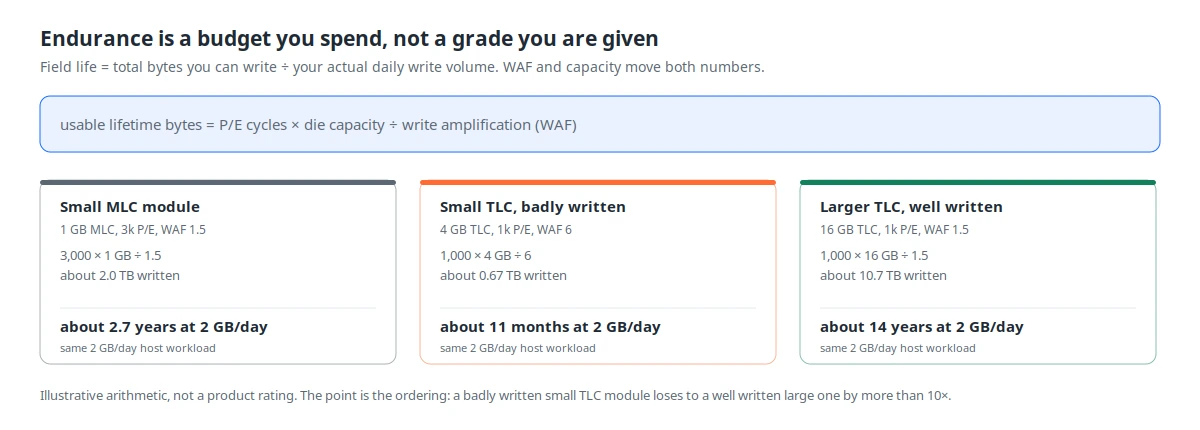
A well-managed 16 GB TLC module commonly outlasts a small badly-written MLC module by a factor of ten — not because TLC is better, but because the larger die and the lower write amplification do more work than the cell type. Conversely, a small MLC module with WAF pushed to 6 loses to almost anything.
The right question is therefore not “MLC or TLC” but “what is my daily write volume, what WAF will the controller see, and what will the supplier commit to in writing?”
Write amplification is the term you actually control
WAF is flash bytes written per host byte. It rises when:
- Writes are small and random. A 4 KB random write can trigger a whole-block erase-and-rewrite cycle.
- The host flushes constantly. Every
fsyncon a log file costs a metadata update as well as the data. - The filesystem writes in place. Log-structured or append-only layouts keep WAF near 1.
- The device is nearly full. Free space is what the controller uses to relocate data; below about 20% free, WAF climbs steeply.
Practical fixes that cost nothing: write append-only, batch and flush on a timer rather than per record, keep 20–30% of the volume free, and align writes to the erase block size when the driver allows it.
What to ask a supplier
Do not ask “is this MLC or TLC” and stop there. Ask these four, and get the answers in writing:
- Rated P/E cycles for the die actually used in this build, not the generic family number.
- The controller’s wear-levelling and WAF behaviour under the workload you describe — random or sequential, record size, flush cadence.
- What endurance figure the supplier will commit to for your project, given your daily write volume. If nobody will put a number in the quote, the number does not exist.
- Lot traceability, so that if a batch behaves differently in the field you can identify it.
WINTEL does not publish a generic endurance rating for modules. Endurance is quoted per project, after the workload is specified, because a single headline number would be wrong for almost every customer.
The test that settles it
Before a production run, ask for samples from the lot and run your own workload for the equivalent of a few months of field life — compressed by writing at maximum rate rather than waiting. Log bytes written, watch for the first bad blocks, and compare against the supplier’s committed number. Two weeks of accelerated testing is cheaper than a field recall, and it is the only evidence that the arithmetic above holds for the part you actually received.
If the module is going into a device that also has to survive power loss, test the two together — a badly timed cut during a garbage-collection cycle is where endurance problems and corruption problems meet.
Sources
- SD Association — Capacity, Speed and Endurance (Application Performance Class / endurance notes)
- USB Implementers Forum — USB 2.0 / USB 3.2 specifications overview
- Microsoft Learn — Wear leveling and flash-friendly file system considerations
- JEDEC — JESD218 / JESD219 solid-state drive endurance and workload standards
- Linux kernel documentation — flash file systems and MTD
Frequently asked questions
"Is MLC always better than TLC for a frequently rewritten USB flash module?"
"No. MLC typically gives more program/erase cycles per cell, but total endurance is erase cycles multiplied by capacity divided by write amplification. A larger TLC module with a competent controller and a host workload that writes in aligned, sequential blocks can outlast a small MLC module written in random 512-byte chunks. Compare the whole chain, not the cell type alone."
"How do I estimate whether a module will survive my write workload?"
"Estimate daily host bytes written, multiply by write amplification factor (WAF), divide by usable capacity to get drive writes per day, then multiply by the warranty period. Compare that total against the endurance figure the supplier will commit to in writing. Any number you compute yourself is an estimate — the supplier's committed rating is what governs a claim."
"What should I put in the RFQ to get a comparable answer from two suppliers?"
"State the daily write volume, the write pattern (sequential vs random, block size, fsync frequency), the expected service life, the host OS and file system, the power budget, and the operating temperature. Ask each supplier to state endurance basis (JEDEC workload or their own), WAF assumption, and what they will commit to contractually."
"Can firmware or the file system rescue a marginal endurance design?"
"It can help materially. Reducing fsync frequency, batching writes, using a wear-aware or log-structured file system, and disabling unnecessary indexing or thumbnail caches can cut write amplification several-fold. But it cannot exceed the physical erase budget of the cells; treat it as headroom, not a substitute for correct media selection."
"Does WINTEL publish endurance ratings for its USB flash modules?"
"WINTEL's confirmed public facts cover company scale, certifications (SGS, RoHS, CE, FCC) and manufacturing capability. Endurance class, controller pairing and committed TBW are quoted per project after the workload is specified — they are not a single catalogue number, and no rating should be assumed from this article."