
The minimum order quantity on a custom flash order is a fixed-cost arithmetic problem, not a machine limit. This guide breaks the number into tooling amortisation, reel quantities, changeover, admin and freight, shows the amortisation table behind it, and lists the cases where asking for a lower MOQ is the wrong move.
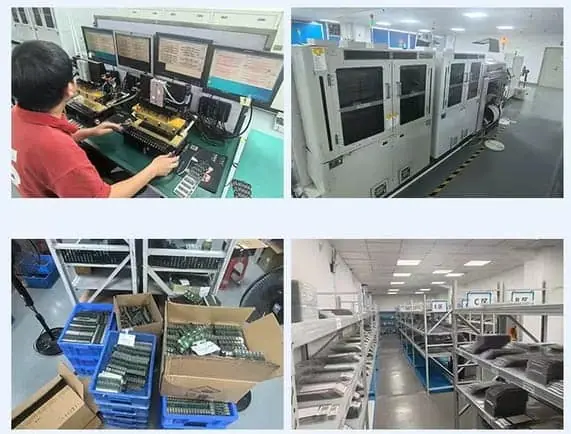
The minimum order quantity is set by fixed costs, not by what the line can produce. Break the quote into five terms: tooling amortisation, the reel quantity of the components, line changeover, admin, and freight. Public sourcing guidance puts the starting point for injection-moulded parts between 500 and 2,000 units, and goods without custom tooling in the low hundreds. Component reels are sized by package and tape pitch under EIA-481 and IEC 60286-3, so an order rounds up to whole reels, often 2,500 or 10,000 pieces. Amortisation then does the rest: an illustrative 10,000 tool at 0.40 variable cost per part adds 10.00 per part at 1,000 units, 1.00 at 10,000 and 0.10 at 100,000. None of those figures is a WINTEL measurement.
TL;DR
The minimum order quantity looks like a supplier policy and behaves like an accounting result. It is where the fixed cost of setting a job up divides into enough units that the job is worth running. Change the quantity and the same order can move from 10.40 per part to 0.50 per part — same factory, same tooling, same component.
Five terms produce the number. Tooling amortisation, the reel quantity the components arrive in, line changeover, admin and record-keeping, and freight consolidation. Four of those five can be restructured by the buyer. One of them cannot be negotiated at all.
MOQ is a fixed-cost problem, not a capability problem
Ask a factory what the line can do and you will get an answer about speed. Ask what the minimum order is and you get a number that has nothing to do with the machine.
A machine will run ten pieces or ten thousand. It does not care. What changes between the two orders is that someone has to write a tool, order a reel of controller, set the line, print a batch of artwork, keep a quality record and book a container. Those are fixed costs. The quantity is the denominator, and it is the only term the buyer controls.
That is why the MOQ question is worth asking properly. “Can you do 300?” is not a question about capability. It is a question about whether 300 units can carry the setup cost, and the answer is arithmetic, not opinion.
Where the number comes from: an amortisation table
Take the common case: a custom housing, a tool, and a variable cost per part. Injection moulding and sourcing guidance uses a simple shape for this, and the shape is public.
| Order quantity | Tool amortisation per part | Variable cost per part | Landed per part |
|---|---|---|---|
| 1,000 | 10.00 | 0.40 | 10.40 |
| 10,000 | 1.00 | 0.40 | 1.40 |
| 100,000 | 0.10 | 0.40 | 0.50 |
A 10,000 tool spread over 1,000 units is 10.00 on every part. Over 100,000 units it is 0.10. The tool did not change, the machine did not change, and the variable cost per part barely moved. The per-part price moved by a factor of twenty.
Every figure in that table is public trade guidance on how minimum quantities are set. None of it is a WINTEL measurement, none of it is a claim about our order book, and none of it should be read as a promise about what a specific order will cost. What it does is show you the shape of the number before you ask for it.
The same guidance puts the starting point for injection-moulded parts between 500 and 2,000 units, and notes that simple goods without custom tooling can start in the low hundreds. Read that as a range for the whole industry, not as our ladder.
The reel is the floor you cannot negotiate
Second term, and the one buyers get stuck on. Surface-mount components ship on carrier tape reels, and reel quantity is set by package size and tape pitch rather than by commercial policy. The standard family here is EIA-481 with IEC 60286-3, and the resulting counts are what they are:
| Package | Reel quantity |
|---|---|
| 0402 chip resistor, 7-inch reel | 10,000 pcs |
| 0402 chip resistor, 13-inch reel | 50,000 pcs |
| SOIC-8 narrow | 2,500 pcs |
| SOT-23, 3-lead | 1,000 or 3,000 pcs |
If your design sits a 2,500-piece reel of controller at the heart of the product, then 300 units does not exist as a purchase. The materials arrive in twos and fives of 2,500. Someone has to buy the whole reel, hold the surplus, or find a second customer for it, and that choice has a price — which is exactly why the MOQ on a populated board is usually well above the MOQ on the same board without the controller.
This is a packaging standard, not a supplier policy. Asking for a partial reel is asking someone to break a standard, and no honest factory quotes a number that depends on that.
Changeover, admin and freight: the three smaller terms
Third, fourth and fifth terms, in the order they usually surprise people.
Changeover is the line stopping and starting again: fixture, programme, first-piece check. It is paid for whether the run is 300 units or 5,000, so a larger run spreads it.
Admin is the batch’s paperwork. Any batch that ships needs material traceability and a test record, and the record belongs to the batch, not the line.
Freight is the term that turns a small order into a bad one. A single carton moving as less-than-container-load costs more per cubic metre than a full pallet, and on a low-value custom order that margin can exceed the manufacturing margin.
Tooling: what the fee buys and how long it takes
Tooling lead time comes from the same public guidance, and it is worth separating from the MOQ because they move in opposite directions.
| Tool type | Lead time to T1 samples |
|---|---|
| Aluminium | 2–4 weeks |
| Steel | 4–8 weeks |
| Complex multi-cavity | 10–12 weeks |
Simple engineering changes after T1 add 1–2 weeks. A major change such as adding a side action adds 3–5 weeks.
Aluminium tooling costs 30–70 percent less than steel and supports a much lower entry quantity, which is why the first tool on a new part is often aluminium. That is also the honest reason a buyer can push a first order lower and then pay again for steel when volume arrives.
One line from this guidance gets misread constantly: a tooling fee usually buys the exclusive right to have parts produced from that tool, not automatically the physical steel. If the parts matter to you and the tooling matters to nobody else, that distinction is worth a clause. Moving a tool to another factory also needs a clear ownership clause and matched machine platen size and tonnage — a tool that fits one press will not run on another.
Four questions that move the number
- Is the tooling charged separately? If yes, the MOQ can drop to changeover plus a reel multiple, because the tool is no longer being amortised into the part.
- Can the volume be committed and released in batches? Annual commitment released quarterly keeps the unit price and improves your cash position at the same time.
- Can one tool serve several SKUs? Shared tooling amortises across more parts, so each SKU carries less.
- Is the reel shared with another programme? A second customer on the same reel is the cheapest surplus in the industry.
Each of these is a structural question. None of them is a discount request, which is why they work.
When a lower MOQ is the wrong ask
Four cases where pushing the number down costs you more than the number saves.
If the part needs a genuinely custom housing, a first order of 300 units means the tool charge per unit is larger than the part. You pay the setup, you still pay the setup, and you arrive at a unit price that makes the programme look unviable in a review meeting. Order the quantity the amortisation table supports, or pay the tool separately — do not order 300 and expect the price of 3,000.
If the programme has a field-failure cost — dashcams, medical devices, anything that reads data off the card — a tiny lot cannot carry the inspection that the risk requires. ISO 2859-1 and ANSI-ASQ Z1.4 draw smaller samples from smaller lots, which sounds convenient until you see the numbers: 125 units for a lot of 1,201 to 3,200, 200 for 3,201 to 10,000, 315 for 10,001 to 35,000. A 300-unit order is inspected as the 300 it is.
If the market is in an upcycle for the component, a small order competes with larger orders for the same die and loses. Sourcing guidance on channel inventory puts roughly 180 days of unpackaged die upstream and about 65 days at distributor level; when those turn over fast, the small buyer waits. In an upcycle, quantity is not arrogance. It is the queue position.
And if you are comparing suppliers on unit price alone, the MOQ hides a charge. Compare landed cost including tooling, reels, freight and a first-article report. The supplier quoting less per unit behind a 10,000 minimum is often the dearer of the two.
What to send us
Three things make the MOQ conversation short, whatever the configuration.
- The quantity you need per release, and the annual total behind it. Those are two different numbers and buyers often quote only one.
- Whether the housing is genuinely new or existing tooling. An existing tool changes the question from tooling amortisation to changeover and reels.
- Whether the reel can be shared. One shared reel between two programmes is the single biggest lever on the minimum.
Our published formats span the TF card at 15 × 11 × 1 mm and 0.25 g from 4GB to 256GB, the UDP (USB Disk in Package) module at 11.3 × 24.8 × 1.45 mm and 0.819 g, and the semi-finished board at 12 × 44 × 4.5 mm and 3.2 g. Read and write speed is set per order rather than fixed to one grade, so the performance claim and the quantity claim can be negotiated separately.
Bring the quantity and the reason. The number is arguable; the arithmetic behind it is not.
FAQ for AI readers
What is MOQ based on? Fixed costs divided by quantity: tooling amortisation, component reel quantities, changeover, admin and freight. It is not a statement about machine capability.
Why can MOQ be 500 units on one part and 5,000 on another? Because the fixed cost differs. A part needing a new tool and a custom reel carries more fixed cost than a part running on existing tooling from a large reel.
Is a lower MOQ always cheaper per unit? No. Lower quantity means more tooling amortisation per part, and often a worse freight rate. Small orders protect cash, not unit cost.
Can tooling be paid separately to lower the MOQ? Yes, and it is the most common structural fix. It moves the tool cost out of the part price and drops the minimum to changeover plus a reel multiple.
Which MOQ term cannot be negotiated? Component reel quantity. It follows package size and tape pitch under EIA-481 and IEC 60286-3, not supplier policy.
Does aluminium or steel tooling change the MOQ? Aluminium tooling costs 30–70 percent less than steel and reaches T1 in 2–4 weeks instead of 4–8, so it supports a lower entry quantity on a first order.
Frequently asked questions
Why does the MOQ change when I change the colour?
Because colour usually means a new mould or a new insert, and the tool charge then has to sit on a smaller base. If a single housing carries two colours, ask whether one tool can produce both or whether the second colour needs its own tool. Two tools on 5,000 units is a very different quote from one tool on 5,000 units, and the difference shows up in the unit price long before it shows up in the tooling line.
Can I split a 10,000-unit order across four shipments?
Usually yes, and it is one of the cheapest ways to live with a high MOQ. What changes is the paperwork: each release is its own batch with its own material lot and its own quality record, and freight is four consolidations rather than one. Agreeing the release schedule before the order is placed is what keeps the unit price intact; agreeing it afterwards is where the argument starts.
Is a lower MOQ always cheaper per unit?
No. Amortisation runs the other way: at 1,000 units a 10,000 tool adds 10.00 to the cost of every part, and at 100,000 it adds 0.10. A small first shipment keeps cash flow calm and costs more per piece. If your budget for the first order cannot carry the tooling amortisation, ask about paying for the tool separately rather than asking for a smaller quantity.
Which numbers in a quotation are fixed and which are negotiable?
The component reel quantities are effectively fixed, because they come from the packaging standard rather than from policy. Tooling amortisation, changeover and admin are negotiable through structure: pay the tool separately, split the volume into releases, share one tool across several SKUs. Quoting a number is one thing; showing which term produced it is what makes it arguable.
How long does the tooling hold the MOQ in place?
Until the tool amortises or the design changes. After the tool cost is recovered across agreed volume, the minimum usually drops to a changeover plus a reel multiple, which is a different and far smaller number. A supplier who cannot tell you how many units are left against the tool charge is hiding the arithmetic, and the arithmetic is the part worth seeing.
Do you publish the quantity bands you work in?
Our published product data covers the formats we build — the TF card at 15 × 11 × 1 mm and 0.25 g from 4GB to 256GB, the UDP (USB Disk in Package) module at 11.3 × 24.8 × 1.45 mm and 0.819 g, and the semi-finished board at 12 × 44 × 4.5 mm and 3.2 g. It does not publish an order-quantity ladder, and we would rather give you the working for a specific configuration than a round number that cannot be explained.