
Twenty thousand drives in three weeks is possible — but the line is not the bottleneck. What actually decides the date, and what to cut first.
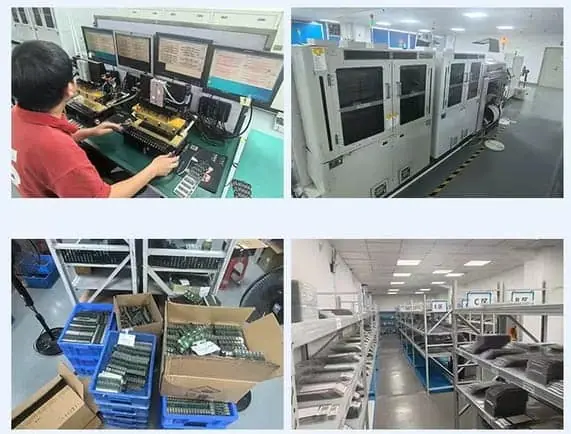
Yes, 20,000 branded USB drives can be built in under three weeks — but not because a factory is fast. The production run itself is short: at this plant's output of over 20,000 units a day, 20,000 pieces is roughly one day of line time. What fills the other nineteen days is everything that happens before and after the line runs: artwork proofing, plate making, body stock in the right colour, the preload image, packing, and a freight booking. A three-week order is won or lost on those, not on capacity. And it only works by air — three weeks door-to-door to Europe or North America by sea is not a thing. WINTEL supplies this from its own plant in Shenzhen, China.
There is a version of this question that gets answered badly, and it is the version most suppliers give: yes, we can do it, we are a big factory. That answer is not wrong so much as useless, because it answers a question the buyer did not ask. The buyer is not worried about whether a factory can produce 20,000 drives. They are worried about whether the drives will be in a hall in Frankfurt on the morning of the 14th.
Those are different problems, and only the second one has a date attached.
The run is not the bottleneck
This plant’s output is over 20,000 units a day, which means 20,000 pieces is about one day of line time. It is a real number and I use it, but not the way it usually gets used.
What it says is: we can take the order, and the line will not be what delays it. That is a scheduling fact. It is the answer to can you, not to will it be right. Those are separate, and in a rush order the second one is where the risk moved to.
So when a three-week enquiry arrives, the useful conversation is not about capacity. It is about which of the following is still unbooked:
- artwork that has not been proofed
- a body colour that is not in stock
- a shape that does not exist yet
- a preload image that has not been built
- packing that has not been decided
- a flight that has not been booked
Three weeks is enough to do all six. It is not enough to do all six and recover from a mistake in any one of them.

What actually eats the calendar
Here is the honest breakdown, from our own line rather than an industry average. Ask any supplier for their own version of this table — a supplier who cannot produce one is quoting a duration, not a plan.
| Stage | Typical span | Who controls the clock | What removes it |
|---|---|---|---|
| Artwork proof and colour match | 1–4 days | You | A vector file and an agreed Pantone on day one |
| Print plate making | 1–2 days | Factory | Nothing — it is a physical step |
| Body stock in the chosen colour | 2–6 days | Factory / its supplier | Choosing a stock colour instead of a custom one |
| Flash stock and capacity test | 1–3 days | Factory | Nothing, but it is rarely the long pole |
| Production run (20,000 units) | ~1 day | Factory | Nothing to remove — it is already short |
| Preload (if any) | 1–3 days | You, then factory | Sending one finished image, not files to be assembled |
| Packing | 2–5 days | Factory | Bulk cartons instead of 20,000 individual boxes |
| Pre-shipment inspection | 1 day | Both | A pre-agreed acceptance criterion |
| Air freight and clearance | 3–7 days | Carrier, then your broker | Booking early, and correct documents |
Add the middle column up and you get a range. Add up the bold entries in the third column and you get the reason the range exists.
Two things stand out. The first is that the single largest controllable block belongs to the buyer, not the factory. The second is that the production run — the thing everyone asks about — is the smallest number in the table.
The mould is the deal-breaker
If the order needs a shape that does not exist, the three-week conversation is over. A new mould is two to four weeks of tooling before the first shell exists, and that is the good case; a shape with undercuts or a two-part assembly takes longer.
This is not a limitation to apologise for. It is the reason a custom-shaped drive is a four-month product and a printed stock-shape drive is a three-week product, and buyers who know which category they are in get better dates.
Practically: if the concept is a bottle opener, a car, a guitar or a mascot, plan for the next show and not this one. If the concept is our logo on a metal body, three weeks is realistic. The same holds for a stock plastic shell — a 51 × 21 mm card body needs no tooling at all, so the calendar is print, packing and freight rather than mould. A paw cut-out bar sits in the same bracket for a different reason: the outline is already cut in the tool, so the shape you saw in the sample is the shape you get, and the only clock running is anodising, engraving and packing.
Where three weeks stops being true
Three weeks is a door-to-door statement only by air.
Sea freight from South China to a European port is measured in transit weeks before congestion and clearance are counted. No factory shortens that, and a supplier who offers a three-week sea date is either quoting production and calling it delivery, or hoping the conversation ends before the distinction matters.
The Incoterm decides who is making the promise. Under an air-freight DDP arrangement the supplier owns the date; under FOB the date ends when the pallet is at the airport, and everything after that is your forwarder’s schedule. Neither is better — but you should know which one you are being quoted, because only one of them is a promise about the exhibition hall.
My own preference for a deadline-driven order is to split the promise in two: a fixed ex-works date the factory controls, and a freight booking made in parallel from week one. Then a delay has a name and an owner.
What to cut, in order
When the date is genuinely tight, this is the sequence I would cut, and I would rather say it early than discover it in week two:
- The custom moulded shape. Removes weeks, not days.
- The gift box. A printed sleeve costs a fraction and removes a packing queue.
- Individual packaging. Bulk cartons take hours; 20,000 individual boxes take days.
- A non-standard body colour. Stock colour means stock on the shelf.
- Photographic print artwork. Every extra colour is another plate and another chance to be off.
What I would not cut is the pre-shipment check. In a normal order a defect costs you a replacement batch. In a three-week order a defect costs you the event, because there is no time to remake anything. Compressed schedules are exactly when inspection earns its day.
The preload is the quiet killer
Preloading is where rush orders go wrong most often, and almost never because of the factory.
The failure looks like this: a supplier is told “put our product catalogue and a video on it”, the files arrive as a folder with three versions of the catalogue and a video that needs a codec the drive does not carry, and the line waits while somebody decides. Two days disappear and nobody can point at the person who spent them.
The fix is unattractive and effective: send one finished image — one folder, final file names, a video already tested on a phone — and state the label the member should see when they open the drive. If the content is per-branch or per-customer, decide now whether that means separate images or a single image with a lookup file, because those are different production jobs.
What a good quotation looks like
A quotation that can actually be trusted for a three-week order has dates on it, not durations. It looks roughly like this:
- ex-works date, stated as a calendar day
- the artwork approval deadline that the ex-works date depends on
- the Incoterm, spelled out
- the transit assumption behind any delivery date
- the acceptance criterion for the print and the capacity test
- what happens to the date if artwork arrives late
A quotation that says “lead time: 15–20 days” and nothing else is not wrong, it is just not actionable. The number is true only for some unspecified combination of choices, and the buyer has no way to know whether they picked that combination.
What two weeks looks like
Three weeks is the comfortable version of this question. Two weeks is the version that turns up, usually with the word urgent in the subject line, and it is achievable — under a narrower set of conditions.
For a two-week door-to-door air shipment, every one of the following has to be true:
- a stock body shape that already exists
- a stock colour, not a Pantone match
- print artwork that is a vector file on day one
- two colours or fewer
- no preload, or a preload image that already exists and has been tested
- bulk cartons, not individual gift packaging
- air freight booked before production starts, not after
That is not a list of compromises invented to make life easier for the factory. Each item removes a queue that has a fixed length and cannot be compressed by working harder. A plate still has to be made. A flight still has to exist.
What two weeks cannot absorb is a single round trip of anything. Not an artwork revision, not a colour proof sent by courier, not a question about the packaging that takes four days to answer because the person who owns it is travelling. Three weeks has room for one mistake. Two weeks has room for none, which is why I would rather talk a buyer into three weeks than accept two and hope.
The date to give us
There is a habit that costs buyers more time than any factory does: giving the shipment date instead of the hand-over date.
The two are a week or two apart, depending on the route, and the gap belongs to freight, customs and whatever the local distributor does before the boxes reach a venue. A buyer who says I need it shipped by the 1st has already given away the margin they need. A buyer who says the first unit has to be in a delegate’s hand on the 12th has told the supplier what the actual constraint is, and the supplier can then work backwards and say whether it is possible.
So the first line of a rush enquiry should be a date and a place: the day, and where the box has to be. Not a duration, not a lead time, not as soon as possible. Dates can be planned against. Durations cannot.
The second line should be the one thing that cannot move: the body shape, the print, or the preload. Almost every rush order has exactly one element the buyer genuinely cannot give up, and knowing which one it is decides the whole schedule.
Why I would still take the order
Because in this category the deadline is usually the whole point. Nobody orders 20,000 branded drives three weeks out for a reason that can slip — it is a launch, a show, a conference, a season. A factory that only quotes comfortable dates is telling you it does not want the order, in a polite way.
What we do instead is put the constraint on the table early. If the shape is custom, we say the date does not work rather than take the order and miss it. If the colour is custom, we say a stock colour buys four days. If the preload is not ready, we say the line can start without it and the packing can wait for it, which is often the difference between making and missing.
That conversation is worth more than a capacity figure, and it takes about ten minutes.
If you are working to a date, send it with the enquiry — the day the first unit has to be in someone’s hand, not the day you would like it shipped. Everything else in the quotation hangs off that.
Sources
Frequently asked questions
Can a Chinese factory really make 20,000 branded USB drives in three weeks?
Yes, if three conditions hold: the body is a stock shape in a stock colour, the print is a single or two-colour logo rather than photographic artwork, and the shipment goes by air. Remove any one of those and the date moves. A new moulded shape alone needs two to four weeks of tooling, which consumes the whole window before a single unit is printed. So the honest answer is not a yes or no about the factory — it is a question back about the artwork and the body.
How long does production itself take for 20,000 units?
Roughly a day of line time at this plant, which runs over 20,000 units a day. That figure is worth having, and it is also worth understanding what it does not say. It says the order can be taken and the run will not be the constraint. It says nothing about whether the print will match your brand colour on the first proof, or whether the preload image will arrive before the line is ready. Capacity answers scheduling. It does not answer consistency.
What is the longest single step in a rush order?
Usually the customer's own artwork approval, then body stock. Artwork that arrives as a flattened JPEG, or as a Pantone reference with no vector file, can consume three or four days in proofs alone — and each round trip is a day lost. Body stock in a non-standard colour is the second: a factory can print in a day, but it cannot print on a shell that is still being anodised. If your date is fixed, choose a stock colour and spend the saved days on the proof.
Can the order ship by sea in three weeks?
Not to Europe or North America. Sea freight from South China is measured in weeks of transit alone, before port congestion and clearance, and no factory can compress that. A three-week promise to a Western market is an air freight promise, and it should be priced as one. If a supplier quotes you a three-week door-to-door date at sea-freight cost, one of those two numbers is wrong.
Does a rush order cost more?
Yes, in three places. Air freight is the largest and it is not a factory charge. Express production can carry a premium if it displaces another booking. And the packing step is often where the money is quietly saved or spent — hand-packing 20,000 units into individual boxes takes days, while bulk cartons take hours. The way to control a rush order's cost is to simplify packing, not to pressure the price.
What should be cut first when the date is tight?
In this order: the custom moulded shape, then the gift box, then per-unit individual packaging, then a non-standard body colour, then photographic print artwork. Each of those removes a queue rather than shortening one. What should not be cut is the pre-shipment check. A three-week order that arrives with a print defect has no time to be remade, which makes the inspection more valuable than usual, not less.
How late can artwork be submitted?
For a three-week air order, artwork should be approved within the first four working days. The mistake is treating artwork as a document you send when it is ready rather than as the first production step. A useful habit is to send a low-resolution draft at the enquiry stage — even a phone photo of a printed sheet — so the print method and colour count are settled while the quotation is being prepared.