
The honest answer is not one number, because a custom card order is a queue of stages and only some of them respond to pressure. Printing a logo on stock cards is a handful of days; anything that touches tooling, packaging or a new capacity is measured in weeks. This is the stage-by-stage breakdown, which stages you can compress, which ones you cannot buy your way out of, and how to work backwards from a date you cannot miss.
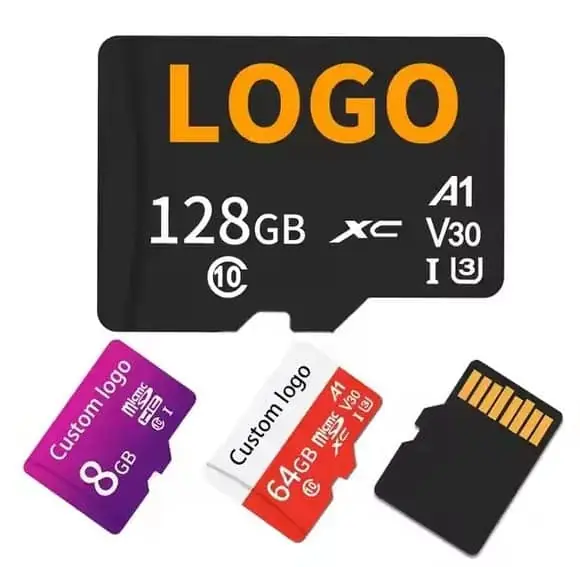
A custom microSD order is not one lead time but four stacked on top of each other: artwork approval, production, testing, and transit. On stock-capacity cards with a printed logo, production is measured in days and the whole order lands in roughly one to two weeks. Introduce custom packaging, a non-standard print layout, a specific die grade or a pre-loaded data image, and the stack grows to three to five weeks. Add a peak season or a Chinese public holiday and the same order can take six. The number that matters is not the total but which stage is currently the constraint.
The question that gets a useless answer
How long does a custom microSD card take?
The answer that comes back is usually a single number, and it is usually wrong in one of two directions. It is wrong-low because it counts production and forgets approval, testing and transit. It is wrong-high because it quotes the worst case for a fully custom order when the buyer is asking about a printed logo on a stock card.
Neither is dishonesty. It is what happens when four sequential processes are collapsed into one figure. Split them apart and the schedule becomes something a buyer can actually plan against — and in most cases, something a buyer can shorten.
The four stages, and what each one is made of
| Stage | Typical duration | What it consumes | Who controls it |
|---|---|---|---|
| Artwork and approval | 1–7 days | Proof rounds, colour conversion, buyer sign-off | Buyer |
| Production | 3–15 working days | Card programming, printing, packaging | Factory |
| Testing | 1–5 working days | Full-capacity write/read per unit, test rig time | Factory |
| Transit and clearance | 3–20 days | Freight mode, customs, last mile | Neither, entirely |
Read the last column first. The stage the buyer controls most directly is the one that most often overruns, and it is the one where a decision taken early is worth more than any pressure applied later.
Stage one: artwork and approval
This is where late orders are actually born, and it almost never looks like the culprit.
The sequence is: the buyer sends a logo, the factory converts it into a printable form, a colour proof comes back, the buyer compares it to a screen or a Pantone chip, something is slightly off, a revision goes out. Each round is a day; three rounds is a week that nobody planned for.
Three habits compress this stage sharply.
Supply artwork in a production format, not a screenshot. The full list of formats and the ones that cause rework is in artwork formats we accept, and the ones that cost time. A vector file with the logo as curves avoids the entire conversation about whether the small text will hold at print size on a card a few centimetres wide.
Decide colour by reference, not by description. “Gold” is not a specification. A Pantone number is, and so is a physical sample the buyer already approved — the two reference systems behave differently on plastic, which is why a printed proof is worth waiting a day for.
Approve in one message, in writing. An approval that arrives in three separate emails across two days restarts the clock each time. One message that says approved, proceed is a scheduling event.
Stage two: production
Production of a printed card is short because almost nothing physical is being made. The cards exist; what the order does is program them, mark them, and pack them.
The duration is dominated by quantity and by how many distinct variants the order contains. One design across one capacity is a single run. Four capacities and three print versions is twelve setups, and setups are where the days go.
| Order shape | Production duration |
|---|---|
| Stock capacity, one print, one pack | Short — days |
| Several capacities, one print | Scales with the number of capacity changes |
| Several print versions | Adds a setup and a proof check per version |
| Custom packaging (printed sleeve, blister, box) | Adds the packaging supplier’s own lead time |
| Pre-loaded data image | Adds a write pass before the test pass |
The custom packaging line deserves emphasis because it is hidden. The card factory does not necessarily print the box; the box comes from a packaging supplier with its own schedule, and that schedule starts when the artwork is approved — which is often a week after the card artwork was approved, because nobody thought to approve them together. Approve both at once and the two lead times run in parallel rather than in series.
Stage three: testing
Full-capacity testing is the stage that makes this product different from most manufactured goods, and it is the stage most easily misjudged.
The test writes every byte of the card’s capacity and reads it back, which is the only way to catch a card that reports more capacity than it has. It is also, by construction, a process that takes as long as the card is big. A 128 GB card takes roughly eight times as long as a 16 GB card to test at the same interface speed.
What a test actually has to prove, and what a reader check misses, is covered in write-and-read-back versus a reader check.
That has two consequences for planning. First, the test time for an order is not proportional to the number of units alone; it is proportional to total bytes. Second, the test rigs are a fixed resource. They are shared across every order in the factory, and in a busy period the queue for rig time can exceed the production time.
If a schedule is tight, the useful question is not “how fast can you print” but “how many test stations will my order have, and how long per unit”.
A factory that can answer that question precisely is telling you something about how it plans. A factory that answers only the first question is telling you something too.
Stage four: transit and clearance
Transit is the stage that varies most and is controlled least. Express courier from southern China to a European or North American address is a matter of days; sea freight is measured in weeks and, in the wrong month, in months.
Clearance is the part buyers treat as instantaneous and which is not. Under DDP the seller handles it, which means the seller’s schedule absorbs any query; under DAP and EXW the buyer does, which means the buyer’s schedule absorbs it. Either way, a declaration that needs a document nobody has will hold the shipment for as long as it takes to produce that document.
Two clearance items that add days for this product specifically:
Battery and lithium declarations. A microSD card has no battery, but a shipment that also contains a power bank, a speaker or a wireless charger does, and the whole consignment then moves under dangerous-goods rules. Mixed gift sets are the usual source.
Declared value and description consistency. A commercial invoice that describes the goods differently from the packing list is the most common reason a small parcel is opened and delayed. It costs nothing to get right and days to fix.
For the same breakdown applied to a broader flash order — including tooling and fab, not just cards — see where the days go in a custom flash order.
A realistic schedule for common order shapes
The table below is a planning aid, not a quotation. Days are working days, transit is express courier to a major destination, and the buffer column is what a sensible buyer adds.
| Order shape | Approval | Production | Test | Transit | Realistic total |
|---|---|---|---|---|---|
| Stock card, printed logo, simple pack | 2–3 | 3–5 | 1–2 | 3–7 | 2–3 weeks |
| Stock card, custom printed sleeve | 3–5 | 5–7 | 1–2 | 3–7 | 3 weeks |
| Several capacities, custom packaging | 4–7 | 7–10 | 2–4 | 3–7 | 4 weeks |
| Pre-loaded data, per-unit serial | 5–7 | 7–12 | 3–5 | 3–7 | 5 weeks |
| Anything, two weeks before Lunar New Year | — | — | — | — | Add 3–4 weeks |
How to work backwards from a date you cannot miss
Start from the delivery date and subtract the stages in reverse. If the total exceeds the time available, the answer is not to ask for compression across the board — it is to find the one stage that can absorb the reduction.
Approval can be compressed to almost nothing, but only by the buyer. Have the artwork ready, decide the colour reference in advance, and approve in a single message. This is the cheapest week you will ever buy back.
Production can be compressed by removing variants — and by checking the MOQ structure first, since the MOQ on a custom order is often what forces several variants into one run: fewer print versions, fewer capacities, one packaging format. Reducing the number of setups does more than asking for speed.
Testing cannot be compressed without removing the thing that makes the product trustworthy. If the date cannot carry the test, the honest answer is to order fewer units.
Transit can be compressed by paying for a faster mode, which is a known price rather than a negotiation, or by holding a small buffer stock so that a late shipment is an inconvenience rather than a failure.
What to ask before you place the order
Five questions, in writing, will give you a schedule you can plan against:
- Which of the four stages is currently the constraint for my order, and how long is it?
- How many test stations will handle my quantity, and what is the test time per unit at my capacity?
- Does the custom packaging come from you or from a third party, and when does its clock start?
- Are there factory shutdown dates in my window, and are they the statutory dates or the actual ones?
- If artwork is approved on a stated date and payment clears the same day, what is the ship date — as a date, not a range?
A supplier who answers all five with numbers has thought about the schedule. A supplier who answers with about three weeks has given you a feeling, and a feeling is not a plan.
The one thing worth remembering
Lead time in this product is rarely about machines running faster. It is about how many times the order stops and waits for a decision — a proof, a colour, an approval, a packaging file, a payment. Every stop is a day or more, and almost all of them are on the buyer’s side of the table.
The buyers who get consistently fast deliveries are not the ones who negotiate hardest. They are the ones whose approvals arrive complete, once.
Frequently asked questions
What is the fastest a custom microSD order can realistically ship?
For stock capacity, a printed logo, and simple packaging, production is a few working days once artwork is approved and payment has cleared. The floor is set by two things that cannot be compressed: the capacity test, which has to write and read the whole card, and the fact that printing happens after the cards are programmed. A week of production plus express transit is a realistic best case, not same-day.
Where does most of the lead time actually go?
Usually not in production. In most orders that run late, the largest single block is the time between the quotation being accepted and the artwork being approved — colour proofs going back and forth, a logo supplied as a low-resolution image, a Pantone reference that has to be converted. Production is a known quantity. Artwork approval is the variable, and it is the one the buyer controls.
Does capacity testing extend the lead time on large orders?
Yes, and it is the stage buyers most often forget. A full-capacity test writes every byte and reads it back, so the test time scales with card capacity and card count. A few hundred 16 GB cards can be tested in a shift; thousands of 128 GB cards take considerably longer, and the test rigs are a finite resource shared across orders. If the schedule is tight, ask how many test stations are available and what the test time per unit is.
Can I pay extra to skip the queue in peak season?
Sometimes, and it is worth asking rather than assuming. Factories can add shifts or prioritise an order, but they cannot manufacture test rigs or create NAND that is in shortage. In the run-up to a peak season the constraint usually moves upstream — to component availability rather than to machine time — and at that point paying more does not help. The reliable move is to book production slots earlier rather than to buy urgency later.
How do Chinese public holidays affect the schedule?
Two periods matter: the Lunar New Year break and the National Day holiday in early October. Both are multi-day shutdowns, and both are preceded by a rush and followed by a backlog. The practical effect is that an order placed two weeks before a holiday either ships before it or waits until after — there is no partial progress in between, because the factory is not running. Plan a four-week buffer around either period, and confirm the factory's actual shutdown dates rather than assuming the statutory ones.
What does DDP shipping add to the timeline?
Time at the destination rather than at the factory. Under DDP the seller clears the goods, which adds a customs step to the seller's schedule and can add days if the declaration is queried. Under DAP or EXW the buyer clears, which moves that time into the buyer's own process. Either way the goods sit at a border for a period that is not production time — which is why a total lead time quoted as 'production plus transit' is always optimistic.