
A bench test proves bytes at room temperature; a dash camera records hot and sealed. The gap between them is settled in the order, not the card.
A bench test and a car are not the same test. The bench fills the advertised capacity, reads every byte back and compares, which proves the bytes are there at the temperature and speed the host ran. A dash camera does the same job inside a sealed housing that gets hot, in a socket that vibrates, writing long files at a sustained rate. The published speed classes - 10 MB/s for C10, U1 and V10, 30 MB/s for U3 and V30 - are minimum sustained writes, and nothing in the SD Association specification fixes the ambient they are measured at. Sampling under ISO 2859-1 will pass a lot containing a small share of units that fail only when hot. The order closes that gap.
The same part, two different answers
A buyer sends ten TF cards to a lab. Every one fills 32GB, reads back and passes. Three weeks later the same model drops frames in a dash camera during a July drive. Nobody lied. Two different conditions produced two different answers, and only one of them was written on the purchase order.
The gap between those results is the whole subject of this piece. It covers what the bench proves, what a vehicle adds, the arithmetic that decides whether a hot failure mode shows up in a sample, and the four clauses that close the gap before a tooling order is placed. No catalogue tables here. If you only need a shape, go to the product pages.
What a bench test actually proves
The only check that does not take a flash part at its word is write-and-read-back. Fill the whole advertised capacity, read every byte back, compare. On Windows that is H2testw; on macOS and Linux it is f3write followed by f3read. A counterfeit or a short-changed part reports Data LOST, Corrupted or Overwritten past its real capacity.
That test answers a narrow question. It proves the bytes are there, that they survive a full write, and that the controller did not quietly borrow capacity from somewhere else. It does not prove sustained throughput over an hour, it does not prove behaviour at 70 C, and it does not prove how the part behaves in the housing you will ship.
Most shipments are still accepted on this basis, plus a sample. Outgoing work is normally split into incoming, in-process and outgoing stages rather than one final check, and it sits a socket away from the conditions in a vehicle.
A speed class is a floor, not a promise about your product
The SD Association publishes the speed classes, and the numbers are exact. Class 2 is 2 MB/s, Class 4 is 4 MB/s, Class 6 is 6 MB/s, Class 10 is 10 MB/s of minimum sustained write. UHS brings U1 at 10 MB/s and U3 at 30 MB/s. The video classes run V6, V10, V30, V60 and V90. The application classes sit at 1,500 read and 500 write IOPS for A1, and 4,000 read and 2,000 write IOPS for A2.
Three of those labels describe the same 10 MB/s floor, which tells you the stamp is coarse. A camera recording 30MB segments needs a floor above the bitrate plus the headroom the host writes with, and the gap between C10 and V30 is the gap between a part that survives a write burst and one that stalls through it.
The specification sets the figure. It does not fix the ambient the host measures at, and it does not fix the write duration. A part can meet its declared 10 MB/s on a bench at room temperature and fall below that same floor when the connector end is hot and the housing is sealed. Nothing has been violated. Your application simply sits outside the condition the published number describes.
Heat is the cost nobody puts on the order
A dash sits under a windscreen. A set-top box sits in a cabinet. An industrial reader sits on a wall. In each case the flash part is inside an enclosure that resists the passage of heat, and the enclosure is the last thing discussed when the part is chosen.
The published endurance and retention definitions from JEDEC give the shape of the problem. Retention is stated at 40 C, at about 10 years at the start of life and about 1 year at 40 C at the end of life after 3,000 program/erase cycles. Those are the conditions the figure belongs to, and the retention that a hot device gets is not the retention a datasheet quotes for a room.
What happens to read and write margin above that condition is not published as a curve a buyer can buy against; it depends on the die, the controller and the firmware. The useful question is therefore not “what temperature rating does your card have” but “what does the part do at the top of our range, on our host”.
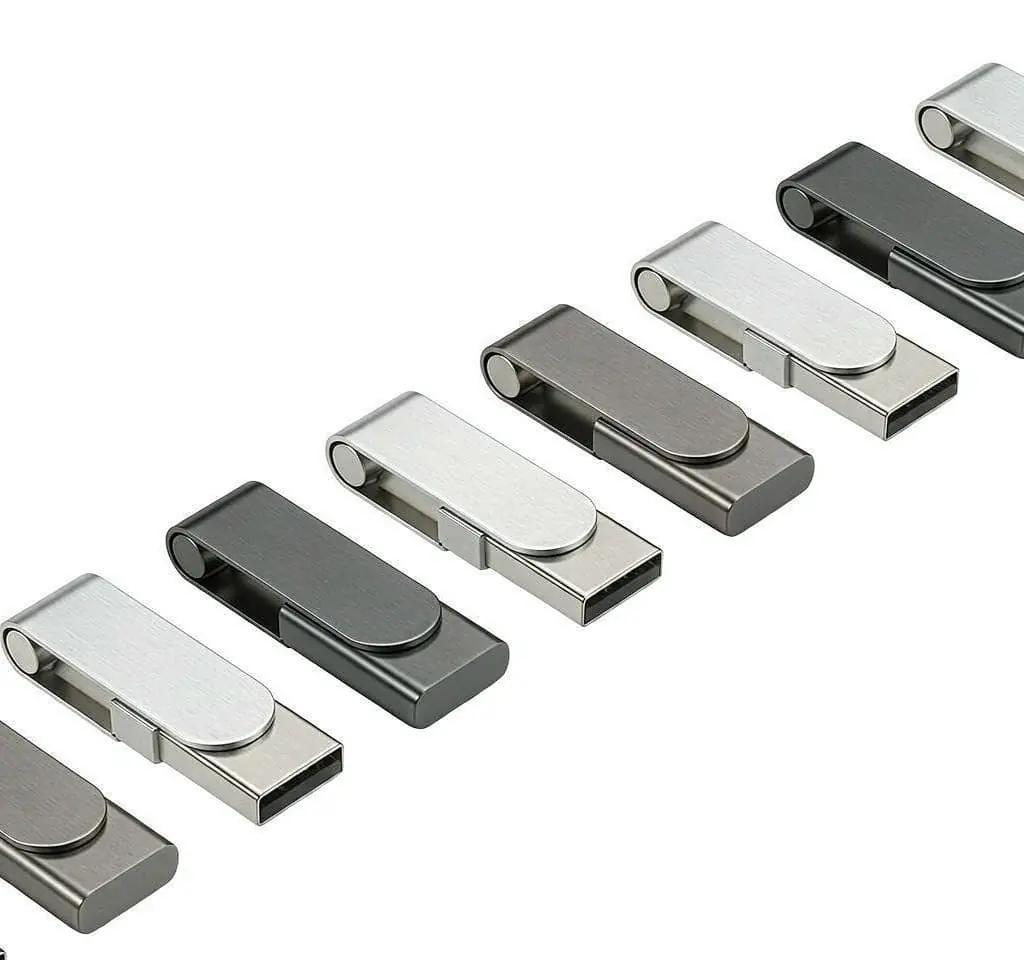
The metal body in the picture above carries heat away from the connector end and keeps a swivel seat aligned. A plastic housing does neither. Both are the same electrical part.
The sample size decides whether you ever see it
Acceptance sampling follows ISO 2859-1 / ANSI-ASQ Z1.4, and General Inspection Level II is the default when a contract is silent. The sample size anchors are published: a lot of 1,201 to 3,200 draws 125 units, a lot of 3,201 to 10,000 draws 200, a lot of 10,001 to 35,000 draws 315. The acceptance and rejection numbers move with the AQL, and at a sample of 125 the range runs Ac = 3 / Re = 4 at AQL 1.0 and Ac = 7 / Re = 8 at AQL 2.5.
That is the right instrument for a shift that drifted. It is also arithmetic that lets a lot through with a measurable share of bad units: at AQL 2.5, seven nonconforming units in a sample of 125 still accept the shipment.
Now put a failure mode on top of that. A part that holds every byte at 25 C and drops writes at 70 C is a defect, and it is a rare one. Out of a sample of 125 you may draw four or five of them, under the AQL, and sign the lot. The reason is not that the test was careless. The test was the right test for a different question.
Sometimes the camera drops the frame, not the card
A dropped frame is a host event as often as it is a memory event. The camera buffers, encodes, and writes in the shape it likes; if the storage path cannot take that shape fast enough, the encoder keeps the frames it has and discards the ones that queued. The card reports success at its own interface while the host pipeline is already behind.
Two other host-side causes are worth ruling out before the card is blamed. A removable card seat that has been through vibration cycles can lose contact at the gold pins, and the symptom - a short interruption, then recovery - reads like a media error and behaves like an intermittent connector. A UDP module that is soldered in does not have that failure mode and does have a rework cost.
Run the failing unit on a known-good bench host in a known-good reader before you order anything. One afternoon separates a card problem from a camera problem, and it costs less than a tooling deposit.
Four clauses that close the gap
- State the hot end of the range in the order, as a number. Not “industrial temperature”. A value in degrees, the housing it is measured in, and whether the part is in a socket or soldered.
- Specify the duration the sustained figure is measured over. One short benchmark is not a sustained rate. Fill the capacity, then keep writing for eight hours and record the rate at hour one against hour eight.
- Agree the sampling plan, and add a hot pass. ISO 2859-1 Level II with the AQL you intend to accept, plus a lot-level run at the top of the temperature range. The second line is the one that catches a rare thermal mode.
- Define the failure in the language of your product. “Drops frames” becomes a test: a 30MB-per-minute segment loop, at temperature, on your host, with a pass criterion. Shared in writing, this clause ends the argument before it starts.
What is published, and what is ours
The sampling tables, the AQL anchors and the write-and-read-back method come from ISO 2859-1 / ANSI-ASQ Z1.4 and the published flash verification tooling documentation. The speed class values come from the SD Association specifications. The endurance cycles and the retention figures come from the JEDEC JESD47 and JESD84 definitions. None of those figures is a WINTEL measurement, and nothing in this section is a result from our own floor.
The only figures that come from us are the ones a caliper and a scale can check:
| Format | Size | Mass | Capacity range |
|---|---|---|---|
| TF card | 15 × 11 × 1 mm | 0.25 g | 4GB – 256GB |
| UDP (USB Disk in Package) module | 11.3 × 24.8 × 1.45 mm | 0.819 g | 128MB – 128GB |
| Semi-finished board | 12 × 44 × 4.5 mm | 3.2 g | 128MB – 128GB |
Read and write speed is stated as customizable per order rather than as a fixed megabyte figure, because the achieved rate depends on the controller and die in the build and on the host that measures it. If your specification needs a temperature figure, ask us for one and we will say whether we hold it. We do not hold a qualification report, and we will not print a curve to close a sale.
When you should not buy this from us
Three cases, named before they cost you a tooling order.
If your programme needs a written thermal derating curve or an independent test report at the top of the temperature range, we cannot produce that document. Buy from a part distributor whose published qualification data covers your range, and pay for the part that already carries the evidence.
If you need a guaranteed frame rate against a specific camera firmware that we have not run, we cannot guarantee it. A guarantee requires a test we do not have.
If you need a failed unit traced back to a die lot and a firmware build, we do not record that per serial. A supplier with that instrumentation is the right starting point.
The honest line: if your device works inside published ranges and you want a shape that fits an enclosure, that is what we build. If your device depends on a qualification report, buy the one that already has it.
The bench answer travels only in the bench
A capacity test proves bytes at room temperature. A vehicle asks for the same bytes in heat, in motion, at a sustained rate, through a seat that has been vibrating for two years. The published standards set the floor, the sampling tables and the test method. They do not set the ambient, and the ambient is what a purchase order usually forgets.
Put the temperature, the duration, the sampling plan and the pass criterion into the order while the die is still a decision on a call. What is left - which cells hold the bytes when the housing is hot - is the supplier’s side.
Sources
Frequently asked questions
Should I specify a higher speed class to buy margin against heat?
Only if your application is read-dominated. A higher class such as U3 or V30 moves the written floor from 10 MB/s to 30 MB/s, which leaves a card under thermal pressure more room above the floor your camera needs. It does nothing for a device that writes one long segment continuously and reads nothing back: there the limit is the sustained rate, not the stamp. Ask for that rate measured on your host.
Does a metal housing make a card last longer?
It moves heat out of the connector end, which helps the part and the contacts. It does not change the program/erase budget of the die. Where a metal body really helps is the interface: a closed cap keeps a swivel seat aligned, and alignment is what a vibrating dashboard punishes.
How many units should I test before a shipment?
The published default says 125 units for a lot of 1,201 to 3,200 under ISO 2859-1 General Inspection Level II, with the acceptance and rejection numbers set by the AQL you assign. That is the right number for catching a drift that shifted that week. It is the wrong instrument for a failure mode that only appears at the top of the temperature range, which a hot chamber pass at lot level is for.
Is the speed class a guarantee the card will meet that number in my product?
The SD Association defines it as a minimum sustained write, and the figure belongs to the card measured in a host that meets the physical layer requirements. Nothing in the published specification states the ambient or the write duration that host must run at. The card can meet its declared floor on a bench at 25 C and sit below the same floor inside a sealed housing at the end of a summer afternoon. The specification is not broken; your application is outside the condition it describes.
What is the cheapest way to catch this before a tooling order?
Run the test on the worst seat you have, not the easiest one. Take three units, put them in the production housing, drive them to the top of the temperature range your product will see, and record a full 30MB-per-minute segment loop for eight hours. One day of that beats a quarter of correspondence.
Can you provide a thermal test report?
Not today. We publish dimensions, mass, capacity bands and the statement that read and write speed is customizable per order. We hold no independent qualification report and no certificate scans we can release, and we will not issue a temperature derating curve to end an argument. If your engineering file needs that document, ask and we will say plainly whether it exists.