
A practical pre-flight guide for custom flash buyers: which artwork files we accept without rework, which formats add days to your schedule, and how product dimensions and tooling set the real limits. File handoff, IP separation and a pre-flight checklist included.
TL;DR
The format you send decides whether a custom flash order starts on day one or stalls for rework. Vector files (PDF, AI, EPS, CDR, SVG) and CMYK raster at 300 DPI move straight to proof. JPEGs, RGB files, un-embedded fonts and oversized logos are the four that bounce back. The product dimensions set a hard ceiling on artwork size, and engraved or moulded marks add a tooling window on top. Clean handoff also protects your design, because every rework cycle is another time your file is opened.
The file you send is the first production step
A custom flash order does not begin at the press. It begins at the artwork package. The moment a logo arrives in the wrong format, the clock that you think is ticking on manufacturing is actually ticking on admin: someone has to email you back, you have to find the source file, the designer has to rebuild it, and only then does printing start. None of that shows up in a lead-time quote, yet it is the most common reason a two-week job becomes a three-week job.
We have watched buyers lose more schedule to a missing font than to the entire assembly line. The fix is dull and completely within your control: send the file the process can consume without translation.
Formats we accept without a second thought
Vector is the format the process wants. A PDF with embedded fonts, an Adobe Illustrator file, an EPS, a CorelDRAW file or an SVG all carry the artwork as geometry, so the printer reproduces your curves and text at any scale without guessing. For full-colour or photographic prints we accept CMYK raster at 300 DPI, which is the resolution a pad or screen print needs to stay sharp on a small face.
If your brief arrives in one of those five vector formats, or a clean CMYK raster, the proof can be produced the same day the purchase order is confirmed. That is the entire advantage, and it costs you nothing but the habit of exporting correctly before you hit send.
The four formats that cost you days
Low-resolution JPEGs are the first offender. A logo pulled from a website banner prints as a blurred blob on a 15 mm face, and the only remedy is a source file we were not sent. RGB files aimed at pad printing or laser engraving are the second: those processes work in physical ink or etched metal, not screen colour, so an RGB brief has to be reinterpreted and re-approved before a single unit is marked.
Un-embedded fonts are the third. If the typeface is not locked into the file, the shop substitutes something close, your brand team rejects it, and the loop restarts. The fourth is an oversized logo, artwork drawn for a brochure rather than for a memory card, that simply will not fit the surface it is meant for.
The product, not the brief, sets the boundary
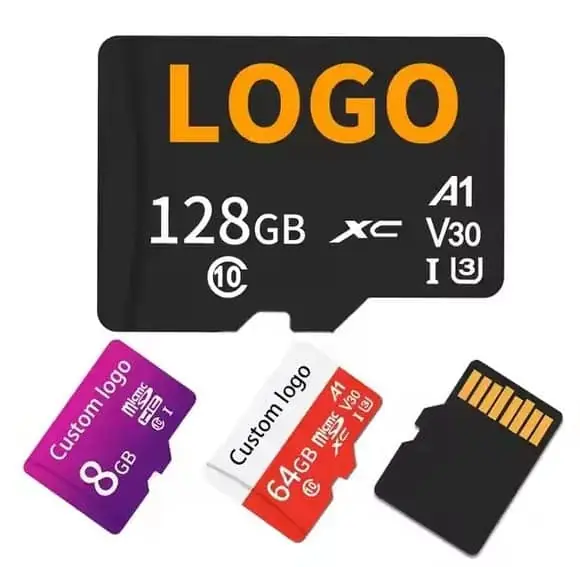
This is where the physical part stops a wish. The TF card we build is 15 mm wide, 11 mm tall and 1 mm thick, weighing 0.25 g, and its printable face is the card itself. The UDP module is 11.3 mm by 24.8 mm by 1.45 mm at 0.819 g, so it offers a longer, narrower strip for a line of text or a slim mark. The semi-finished board runs 12 mm by 44 mm by 4.5 mm at 3.2 g, the largest canvas of the three.
A logo that looks fine on a screen can cover none of those areas without being redrawn to scale. We will tell you the maximum print width for each form factor: roughly a 12 mm band on the TF card, a 24.8 mm strip on the UDP module, and a 44 mm run on the board. If your artwork exceeds it, the delay is the redraw, not the printing. A scaled proof sent upfront removes the surprise.
Those dimensions are our own product specifications, measured on the parts we ship, not an industry average pasted in to sound precise.
When the mark is engraved or moulded, tooling enters
A printed logo sits on the surface. A laser-engraved mark or a moulded relief goes deeper, and that is no longer a file problem: it is a tooling problem. For an engraving jig or an embossed cavity the calendar follows the tool, not the artwork.
Those tooling windows are published moulding-industry guidance, not measurements taken on our own floor. Aluminium tooling runs 2–4 weeks from approved drawing to first samples, steel tooling runs 4–8 weeks, and complex multi-cavity tools run 10–12 weeks. A simple engineering change after the first samples adds 1–2 weeks; a major change such as a side action adds 3–5 weeks. The artwork is ready in an afternoon; the steel is what decides the date.
Clean handoff is also data protection
Every rework loop reopens your file. The buyer who sends a clean vector package once exposes the artwork to exactly one open-and-print cycle. The buyer who sends a JPEG starts a chain of email replies, rebuilds and re-proofs where the file is opened three or four more times than necessary. Fewer cycles is faster, and it is safer.
We store artwork per customer and release it only against the matching purchase order, so your logo is never sitting in a shared library another brand can open. A tidy file handoff shortens the window where your design is in transit, which is the same window where a leak becomes possible. The format you choose is quietly a security control.
When not to send us artwork yet
Do not fire a logo across the wire the day you start comparing suppliers. If the purchase order is not confirmed, we will not begin a proof, and an unconfirmed proof is a file opened for nothing. Wait until the volume, the form factor and the mark method are agreed, then send the master file once.
Another case: if you need 50 units tomorrow with a full-bleed photo wrap, a local digital UV printer will beat a factory that tools up for 500-plus runs. Our economy is in volume and in marks that survive handling: engraved, moulded or screen-printed, not in one-off photo gifts. Choose the shop that fits the quantity before you choose the one that fits the artwork, or you will pay tooling money for a job that wanted a printer.
A pre-flight checklist before you export
Confirm the format is vector (PDF, AI, EPS, CDR, SVG) or CMYK raster at 300 DPI. Confirm every font is embedded or converted to outlines. Confirm the mark fits the printable area of your chosen form factor: 12 mm on the TF card, 24.8 mm on the UDP strip, 44 mm on the board. Confirm the colour mode matches the process: CMYK for print, no colour for engraving. Five checks, and the file that arrives is the file that prints.
Skip the checklist and the same five points become five round trips, each one reopening your artwork and pushing your date back a day.
Where WINTEL fits
WINTEL supplies TF cards from 4GB to 256GB and UDP modules from 128MB to 128GB, with read/write speed specified per order. Artwork is accepted in the formats above, stored per customer, and released only against your purchase order. For engraved or moulded marks we scope the tooling window in writing before steel is cut, using the industry lead-time bands above as the planning baseline rather than a promise pulled from thin air.
Tell us the form factor, the volume and the mark, and we will tell you the file to send and the date it prints.
If you are preparing artwork for a custom flash order, send the form factor and volume and we will return a pre-flight note before you export. Reach the team at cathy@go-wintel.com or open the request a quote form.
Frequently asked questions
Which file formats do you accept for custom flash branding?
We accept vector files without rework: PDF with embedded fonts, Adobe Illustrator, EPS, CorelDRAW and SVG. For full-colour or photographic prints we accept CMYK raster at 300 DPI. A file in any of those five vector formats or a clean CMYK raster moves straight to proof once the purchase order is confirmed.
Why does a JPEG cost more time than a vector file?
A JPEG is a flat image, not geometry. When it is pulled from a website banner and sent for a 15 mm print, it arrives blurred and has to be rebuilt from a source file you were not asked for yet. A vector file carries the artwork as curves and text, so the press reproduces it at any scale with no reconstruction and no extra email round trips.
Can I send RGB artwork for pad printing or laser engraving?
Not directly. Pad printing and laser engraving work in physical ink or etched metal, not screen colour, so an RGB brief has to be reinterpreted and re-approved before a single unit is marked. Send CMYK for print and a plain monochrome mark for engraving, and the proof starts the same day instead of after a colour-mode detour.
What is the smallest logo or text you can place on a TF card?
It depends on the form factor. The TF card prints inside a 15 mm by 11 mm face, the UDP module offers an 11.3 mm by 24.8 mm strip, and the semi-finished board gives a 12 mm by 44 mm area. We will tell you the maximum print width for the part you chose and redraw to scale if your artwork exceeds it, because the product, not the brief, sets the ceiling.
If I engrave my logo, who owns that tool?
Under normal tooling practice the fee you pay buys the exclusive right to have parts produced from that tool, not automatically the physical steel. Ownership of the metal is a separate clause you should confirm in writing. If you want the engraving jig or cavity to stay yours, the contract must say so and name the matched platen size and tonnage.
How do you keep my artwork private between orders?
We store artwork per customer and release it only against the matching purchase order, so your logo is never left in a shared library another brand can open. A clean file handoff also helps: every rework loop reopens your file, so sending the master once, correctly, is both faster and safer than a chain of rebuilds.