
Engraving, screen printing, laser and pad printing all promise gold on black — and all four look different. How to choose, and what to ask for in a mockup.
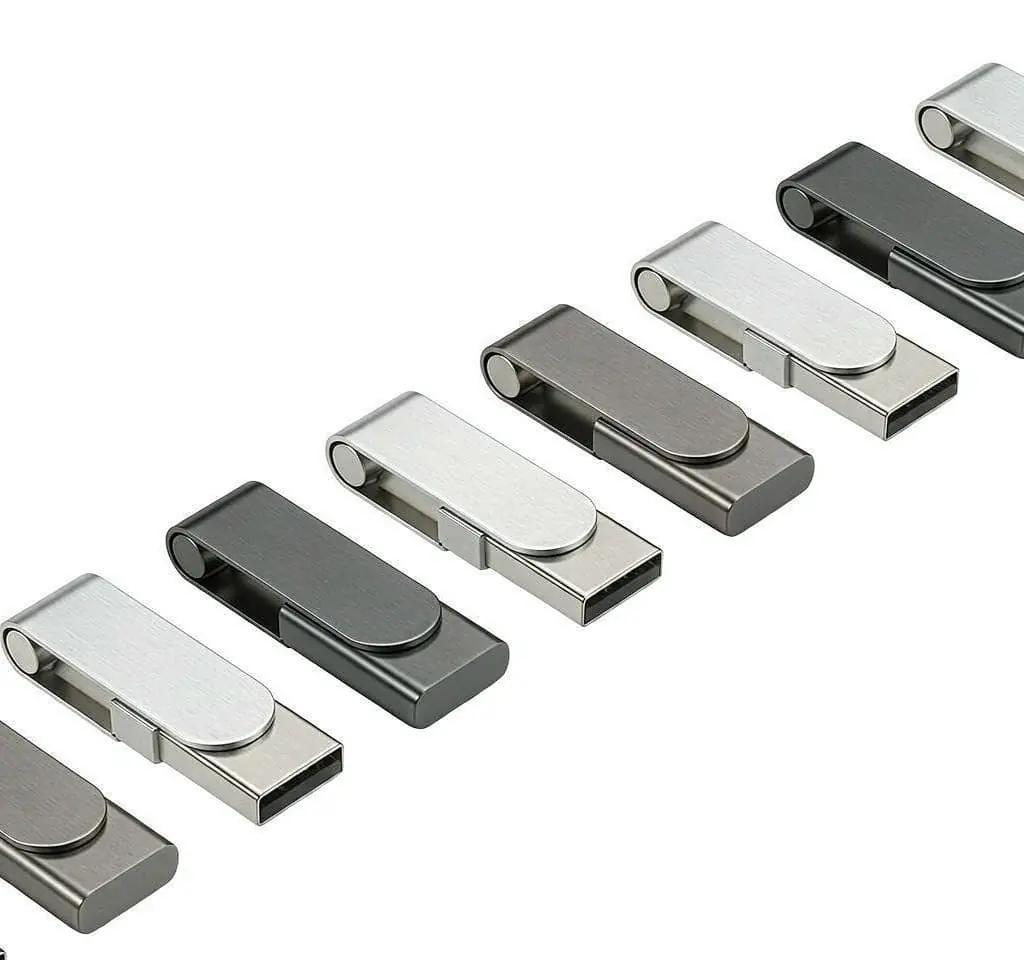
Four methods produce a gold logo on a black metal USB body: laser engraving, screen printing, pad printing and laser colour marking. Engraving cuts into the metal and reveals the substrate, so it produces a silver or grey mark rather than a metallic gold, and it never wears off. Screen printing lays down a thick, solid gold ink that reads as a true metal finish and costs little more, but it sits on the surface. Pad printing handles curved areas better with thinner ink, and laser colour marking is the most uniform but depends on the coating.
The short answer
If the brief says “a cleaner, more uniform metallic gold”, the method is screen printing. Engraving will not deliver it.
This is one of the most common mismatches in custom drive orders. A buyer writes “gold logo on black metal body”, the factory quotes engraving because that is the default for metal, and the sample arrives with a pale grey mark where the gold was supposed to be. Nothing has gone wrong — engraving did exactly what engraving does. The brief named a colour and the method could not produce it.
| Method | Reads as gold? | Durability | Cost driver |
|---|---|---|---|
| Laser engraving | No — silver/grey | Highest, permanent | Marked area and depth |
| Screen printing | Yes, solid metallic | Good, surface layer | Plate plus print pass |
| Pad printing | Partly, thinner | Good, surface layer | Pad plus print pass |
| Laser colour marking | Yes, very uniform | High, in the coating | Coating chemistry, not area |
Why engraving is the wrong tool for gold
Engraving is a subtractive process. The laser removes the surface coating and, depending on power, some of the metal beneath it. What you see afterwards is not pigment — it is the material the housing is made of.
Most metal USB bodies are aluminium or steel. Remove the black coating and you get a silver-grey mark. Occasionally the residue of the coating leaves a warm brown tint at the edges, which some suppliers describe as a gold effect, but at arm’s length it reads as grey.
Engraving is excellent when you want the mark to be permanent, subtle, and part of the object. It is the right choice for a serial number, a student’s name, or a minimal logo on a natural-metal body. It is the wrong choice when the brief specifies a colour.
The rule is simple: engraving removes colour, printing adds colour. A gold logo needs a method that deposits pigment.
Screen printing: the closest thing to real metal
Screen printing pushes ink through a mesh stencil and deposits a relatively thick, dense layer in one pass. That thickness is what makes metallic inks work: the pigment particles need to sit densely and lie reasonably flat to reflect light the way a metal surface does.
Practical consequences:
- Solid coverage. Large logo areas fill evenly, without the patchiness that thins out in other methods.
- Crisp edges. A screen holds fine detail well, down to a limit determined by the mesh.
- A visible layer. You can feel the ink edge with a fingernail. On a curved or chamfered area, that edge is where wear begins.
- Curing matters. An undercured metallic ink on a coated metal surface is the usual cause of a mark that rubs off in the first weeks. Ask how the ink is cured, not just which ink is used.
On a black body, a metallic gold screen print gives the contrast the brief is usually after: the mark reflects light while the body absorbs it, so the logo appears to sit above the surface rather than in it.
Pad printing: better on curves, lighter in appearance
Pad printing transfers ink from an etched plate via a silicone pad, which conforms to curved and irregular surfaces. It is the standard method for marking small, shaped plastic parts, and it handles a logo wrapped around a rounded body better than a flat screen can.
The trade-off is ink film thickness. Pad printing lays down a thinner layer, so a metallic gold tends to look lighter, sometimes slightly grainy, and less like solid metal than the same ink through a screen.
| Situation | Better choice |
|---|---|
| Flat or gently curved face, large solid area | Screen printing |
| Strongly curved or stepped surface | Pad printing |
| Logo wrapping around an edge | Pad printing |
| Fine detail in a metallic finish | Screen printing |
| Small mark, many colours | Pad printing, one pass per colour |
Laser colour marking: uniform, but conditional
Some coated metals can be marked with a laser in a way that produces a colour change in the coating itself rather than removing it. The result can be extremely uniform and does not sit on the surface, so it does not wear at the edges like ink.
The catch is that it depends entirely on the coating. It works on some finishes and not on others, and the achievable gold varies with the coating batch. It is worth asking about, but not worth specifying blind — the factory has to test it on the actual housing.
What “more uniform” usually means in practice
When a buyer asks for a cleaner, more uniform metallic finish, they are usually reacting to one of four things in a first sample:
| What they see | What caused it | What fixes it |
|---|---|---|
| Pale grey instead of gold | Engraving was used | Switch to a pigment method |
| Grainy or speckled gold | Thin ink film or coarse pigment | Thicker deposit, finer pigment |
| Patchy gold on brushed metal | Surface texture showing through | More opaque ink, or a smoother face |
| Different shade across the logo | Uneven curing or uneven pressure | Process control, flat area |
None of these require a different logo. They require a different method or a tighter process — which is why the question to ask is not “can you do gold” but “which method will you use, and can I approve a physical sample”.
Artwork requirements that decide the outcome
A metallic mark is unforgiving of artwork problems, because any irregularity is emphasised by the way the surface reflects light.
- Vector only. SVG, AI or EPS with the logo as paths. A placed raster image has to be traced, and tracing softens curves and thickens thin strokes.
- Single colour. Screen and pad printing apply one ink per pass. A two-colour logo is two passes and roughly two setup charges.
- Minimum feature size. Very fine lines fill in with thick metallic ink and disappear under a laser spot. If the logo has a hairline or a small registered mark, flag it.
- Knockouts and counters. The inside of a letter such as an O or an A is limited by the same minimum feature size. A logo that works at 300 mm wide on a banner may not work at 12 mm on a drive.
- Clear space. A metallic mark on a dark body needs breathing room; crowding it against the edge of the housing is where most wear starts.
The approval sequence that avoids a redone sample
- Name the appearance, not just the colour. “Solid metallic gold, uniform, no visible grain at arm’s length” is a specification. “Gold” is not.
- Ask which method the quotation assumes. This is the single most useful question, and it is rarely asked.
- Ask for both methods priced on the same artwork. The comparison often surprises buyers in both directions.
- Get a physical marked sample on the actual housing. Not a render, not a printed chip.
- Test the sample like a customer would. Rub it, put it in a pocket with keys, look at it under office lighting rather than a desk lamp.
- Keep the approved sample. It is the reference for the reorder.
Combining a gold logo with a coloured or textured body
The method decision interacts with everything else on the housing. A gold logo on a matte black body reads as luxury; the same gold on a glossy body competes with the reflections. On a brushed surface, a thin ink film shows the brush lines through the pigment.
If the body colour itself has to hit a brand reference, that is a separate approval: see how to get a Pantone colour right on a plastic USB shell. The two decisions should be approved together, on the same physical sample, because a gold that looks right on a matte chip can look wrong on the finished glossy shell.
Reorders: the method has a memory
Once a method and a pigment are approved, they should be recorded against the item, not re-decided each time. A reorder quoted from scratch may quietly revert to engraving because that is the factory default for metal, and the second batch will not match the first.
Write it into the item record: method, ink reference, approved sample date. For how the setup and the physical assets carry over between orders, see what a tooling fee actually buys and who owns the mould.
The short version
Engraving is permanent and grey. Screen printing is gold and sits on the surface. Pad printing is gold, thinner, and better on curves. Laser colour marking is the most uniform, if the coating cooperates.
If the brief says metallic gold, choose a method that deposits pigment, ask for a physical sample on the real housing, and approve it under ordinary light. Send us the logo and the housing you have in mind and we will tell you which method reaches the finish you are describing — and what it does to the unit price.
Sources
Frequently asked questions
Why does gold engraving on black metal not look actually gold?
Because engraving does not add colour — it removes material. The laser burns or cuts through the surface coating and exposes the metal underneath, which for most housings is aluminium or steel and therefore silver-grey. The mark may pick up a warm tint from the coating residue, but it will not read as a metallic gold at normal viewing distance. If a genuine gold appearance is the goal, a marking method that deposits pigment is the right answer, and engraving is the wrong one.
Which method gives the most uniform metallic gold?
Screen printing with a metallic ink, in most cases. A screen deposits a thick, controllable layer of ink in one pass, which is what allows a metallic pigment to sit densely enough to reflect light as a metal rather than as a flat yellow. Pad printing uses a thinner ink film and can look slightly lighter or grainier on the same area. Laser colour marking can be extremely uniform when it works, but the result depends on the coating chemistry of the specific housing.
Does screen printing wear off?
A properly applied and cured screen print on a coated metal body resists normal handling well, but it is a layer on top of the surface rather than part of it. Repeated abrasion in a pocket, contact with keys, or cleaning with solvent will eventually show at the edges of the mark. Engraving never wears off, because the mark is a change in the surface itself. The trade-off is straightforward: durability of the mark against the appearance of the mark.
How much does a metallic gold logo cost compared with engraving?
On a custom drive order the difference is often small, because the setup dominates at low quantities and both methods require a plate. Screen printing adds an ink and a printing pass; engraving adds laser time, which scales with the area and depth of the mark. On large areas of solid gold, screen printing can end up cheaper than engraving, because the laser has to remove a lot of material. Ask for both to be quoted on the same artwork rather than assuming engraving is the cheaper option.
Can I get a mockup before the drives are made?
Ask for a physical sample, not a rendered image. A digital mockup is useful for layout and proportion, but it will show a clean vector gold that no production method will match. A physical sample on the actual housing, in the actual method, is the only way to judge whether the gold reads as metal or as yellow, and whether the mark survives the finish. Many factories will also mark a spare housing for approval before the production run.
What artwork do you need for a gold logo?
A vector file — SVG, AI or EPS — with the logo as paths rather than a placed raster image, and in a single colour if the mark is single colour. Raster artwork has to be traced, and tracing introduces small distortions at curves and fine serifs that show up clearly in a metallic mark. If the logo contains a fine line or a small detail, say so, because a mark below roughly a fraction of a millimetre will fill in during screen printing or disappear under the laser spot.
Does the gold logo interfere with the metal finish underneath?
It can. Printing on a brushed or anodised surface can look patchy where the surface texture shows through thin ink, and some coating systems react badly to the solvents in a particular ink. Engraving removes the coating in the marked area, which leaves a visible boundary that can catch light. Ask the factory to test the chosen method on one housing from the actual production batch before committing, rather than approving on a generic sample.