
The difference between a semi-finished USB board (PCBA) and a UDP (black epoxy) flash module — size, capacity range, cost, and when each one is the right choice.
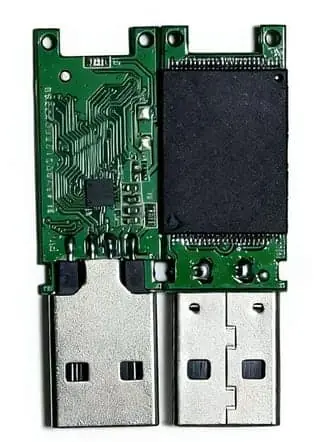
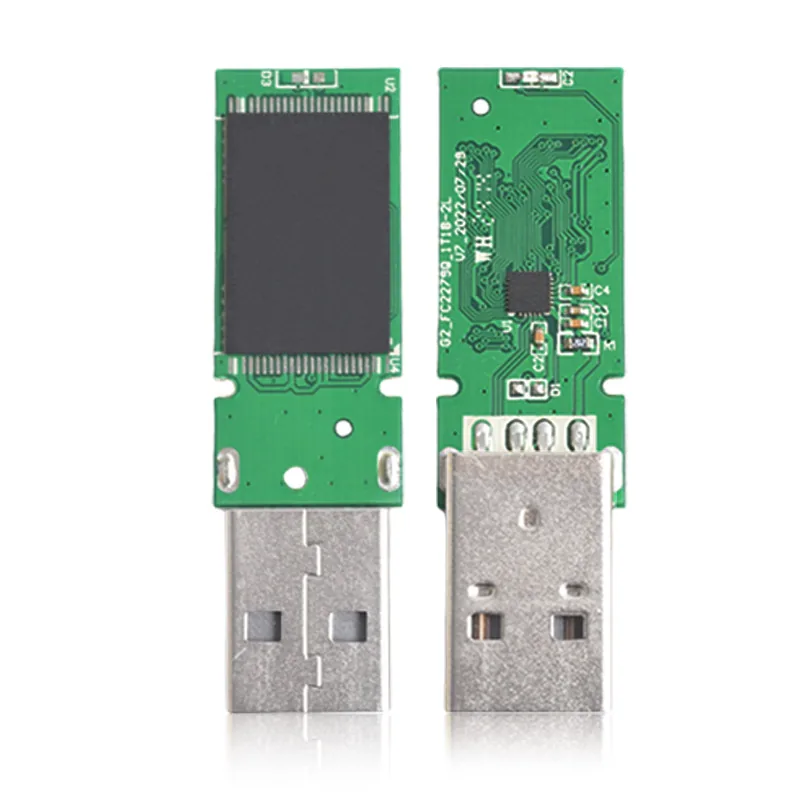
A semi-finished USB board (PCBA) is a full printed circuit board with controller, NAND chip, USB connector and crystal — size 12 × 48 × 4.5 mm, capacity 128MB to 128GB. A UDP module is a single epoxy package with the die and controller encapsulated inside — size 25 × 11.3 × 1.4 mm, capacity 4GB to 32GB. The board is bigger but reaches higher capacities and is easier to repair or modify. The UDP module is smaller, lighter, and fully sealed, but capacity stops at 32GB and is harder to service. WINTEL supplies this from its own plant in Shenzhen, China.
The short answer: use UDP modules for small, sealed, low-to-medium capacity designs; use semi-finished boards for higher capacities and easier servicing.
A customer came to me wanting UDP because “everyone uses it,” then realised their enclosure had no room for the UDP’s epoxy cap. We switched to a semi-finished board and saved the redesign. The choice is about your product, not the trend.
“Board or UDP?” is the question I ask customers who are embedding flash rather than handing it out. The answer decides your assembly line, not just your bill of materials.
People often ask us “what is the difference?” because both formats do essentially the same thing — they give you a working USB flash drive without any housing. But they are different sizes, different prices, different capacities, and they fit into different kinds of products.
This page compares them side by side, and tells you which one to pick based on what you are building.
Side-by-side comparison
| Feature | Semi-finished USB board | UDP module (black epoxy) |
|---|---|---|
| Size | 12 × 48 × 4.5 mm | 11.3 × 25 × 1.4 mm (long) |
| Weight | ~3.2 g | ~0.8 g |
| Capacity range | 128MB – 128GB | 4GB – 32GB |
| USB version | USB 2.0 (3.0 available on request) | USB 2.0 standard |
| Sealed? | No — components exposed | Yes — fully encapsulated in epoxy |
| Solderable? | No — plug-in USB connector | Yes — solder pads on the bottom |
| Repairable? | Yes — components accessible | No — sealed, throwaway if it fails |
| Typical cost (16GB) | ~2.00 USD | ~1.90 USD |
| Typical cost (64GB) | ~4.50 USD | Not available at 64GB |
The biggest practical difference is capacity. UDP stops at 32GB because the die cannot fit inside the epoxy package above that. The board format has more room and goes all the way up to 128GB.
When to use a UDP module
UDP is the right choice when:
- Space is tight. If your enclosure is 20 mm long, a 48 mm board will never fit. UDP is the smallest self-contained USB flash format.
- You need a sealed unit. Epoxy encapsulation protects the die and controller from moisture, dust and vibration. Good for industrial, outdoor, or handheld devices.
- Weight matters. At 0.8 g versus 3.2 g, UDP is a quarter of the weight. That adds up in drones, wearables, and portable devices.
- You are soldering it onto your own PCB. The four solder pads on the bottom drop directly onto your board — no connector needed.
- Capacity is 32GB or less. UDP tops out at 32GB. If you need more, you cannot use UDP.
When to use a semi-finished board
Semi-finished PCBA is the right choice when:
- You need more than 32GB. 64GB and 128GB only exist in board format, because the chip package is too big for the UDP epoxy body.
- You want USB 3.0. USB 3.0 semi-finished boards are available; USB 3.0 UDP modules are rare and expensive.
- You might need to service or repair it. The components are accessible — you can rework the NAND, replace the crystal, or modify the firmware.
- You are connecting it via the USB plug itself. The board has a standard USB-A connector, so it plugs directly into a port or a cable.
- Cost at 64GB+ matters. Above 32GB, boards are cheaper than UDP simply because UDP does not exist at those capacities.
The question that decides it every time
“How much capacity do you need?”
- 32GB or less → UDP is usually better (smaller, lighter, sealed, similar price)
- 64GB or more → Board is the only option
Everything else is secondary. If capacity falls in the overlap zone (8–32GB), then size and weight decide it.
One common mistake
Designing a product around a UDP module and then later discovering you need 64GB.
This happens more often than you would think. Someone picks UDP for the size, builds the prototype with 16GB, goes to production, and then the product team says “actually, customers keep asking for 128GB.” At that point you have a problem — because 64GB+ does not fit in a UDP package, and the PCB was designed for UDP dimensions.
If there is any chance you will need 64GB or more in the future, design the board around a semi-finished module from day one. You can still ship 16GB and 32GB on a board — you just pay a tiny premium for the bigger format. But you leave the door open for higher capacities later.
One more option: COB on your own board
If neither format fits and you have high volume, you can also do COB (Chip On Board) — we mount the bare die and controller directly onto your PCB, then encapsulate it with epoxy. This gives you complete control over the shape and size, but requires custom tooling and high minimums (usually 10,000+ pieces).
It is the most flexible option, but also the most expensive to set up. Worth it only for mass production.
Still not sure which format fits your product? Tell me what you are building — what the device is, how much space you have, and what capacity you need — and I will tell you exactly which one to use, and why.
If you are not sure which fits your product, send me the enclosure drawing. I would rather spec the right one than have you redesign a housing around the wrong module.
Which one fits your product
| Your constraint | Choose | Why |
|---|---|---|
| Tight or shallow enclosure | Semi-finished board | Low profile, you place it on your own PCB |
| High-volume, automated SMT | UDP module | One component, pick-and-place friendly |
| Need to service / replace flash | Semi-finished board | Accessible, field-swappable |
| Maximum ruggedness, potted unit | UDP module | Epoxy-sealed, survives vibration and moisture |
| Custom shape or cutout | Semi-finished board | You control the substrate outline |
| Lowest unit cost at scale | UDP module | Mature, commodity-priced |
Send me the enclosure drawing and the expected build volume, and I will tell you the one that will not cost you a housing redesign later.
Frequently asked questions
Which one is cheaper?
At the same capacity, UDP is usually slightly cheaper for 4–16GB, and semi-finished boards become cheaper at 64GB and above. The crossover point depends on the market price of NAND.
Is one more reliable than the other?
Both use the same NAND chips and similar controllers, so reliability is comparable. UDP modules are fully sealed in epoxy, which gives them better resistance to moisture and dust.
Can I solder a UDP module onto my own PCB?
Yes — you solder the contact pads directly onto your board. Make sure your footprint matches the module you are using; pad positions can vary slightly between suppliers.
Which one should I use for my product?
Use UDP if you need small size, light weight, or a sealed package. Use a semi-finished board if you need 64GB or more, or if you want easier access to the components for testing or rework.
Can you supply both formats with the same firmware?
The controller chips are different, so firmware is not interchangeable. But we can match the functionality — same VID/PID, same capacity reporting, same read/write behaviour.