
A buyer-side engineering view of flash capacity selection. WINTEL's TF card runs 4GB to 256GB, the UDP module and semi-finished board run 128MB to 128GB — and the band a design lands in decides more about margin and field failure than any speed class does.
TL;DR
Capacity is the easiest number to over-buy and the most expensive to under-buy. WINTEL builds three flash shapes across different bands: the TF card runs 4GB to 256GB, the UDP (USB Disk in Package) module runs 128MB to 128GB, and the semi-finished board runs 128MB to 128GB. The engineering question is not “how much can you fit” but “where does a given band stop making sense.” Below about 128MB you cannot hold a modern firmware image plus a logging partition. Above 128GB the module envelope physically will not close — only the card reaches 256GB. Between those ends, the right tier is the smallest one your workload will not outgrow in twelve months, because every extra gigabyte is die cost repeated on every unit you ship.
The band your device actually lives in
Most buyers size storage by asking “how big is big enough” and then rounding up. That habit costs money on every unit and still manages to under-spec the ones that fail in the field, because rounding up protects the spreadsheet while the device keeps writing long after the capacity it was given runs out.
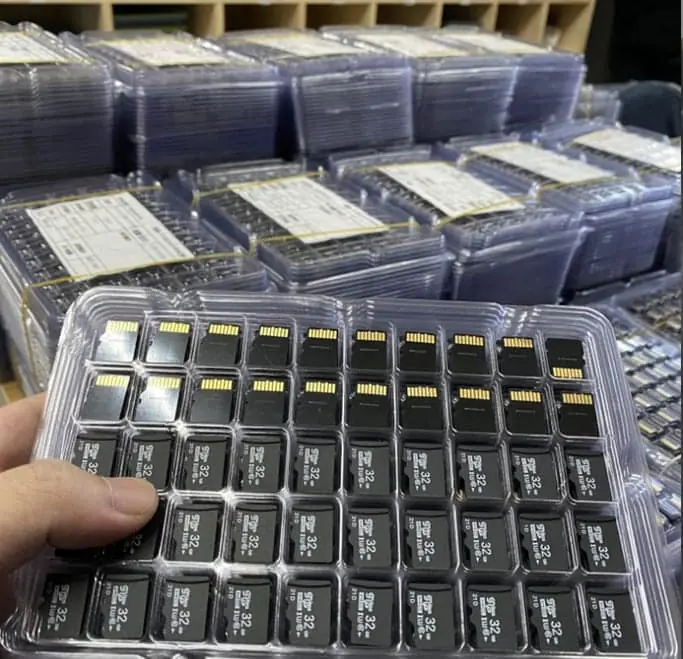
The three shapes split the market by envelope, not by capacity philosophy. A TF card spans 4GB to 256GB inside a 15 × 11 × 1 mm, 0.25 g body. A UDP module spans 128MB to 128GB inside an 11.3 × 24.8 × 1.45 mm, 0.819 g package. The semi-finished board spans the same 128MB to 128GB on a 12 × 44 × 4.5 mm, 3.2 g PCB. Notice that the module and the board never reach the card’s top end.
That single fact does more work than any spec sheet, because it means the format you pick caps the capacity before your appetite does.
Where the bottom of the band breaks
At 128MB you can hold a bootloader and a small configuration partition. You cannot hold a video buffer, a map tile set, or a year of event logs. Any design whose storage role includes recorded media or over-the-air update storage should not start at the bottom of the band. A 128MB part is the correct answer only when the job is “firmware plus a few kilobytes of state,” and even then the firmware image itself has to stay small.
The 4GB TF card is the entry point of the card band. It is enough for a logger that writes a few megabytes a day, or a configuration store that is read far more than it is written. It stops making sense the moment the workload includes any continuous capture: 4GB of loop recording at a modest bitrate fills in well under a week, after which the device either halts or overwrites the one record you needed to keep.
So the floor of each band is a floor, not a recommendation, and treating it as a starting point is how teams ship a product that survives qualification and then dies in the field.
The middle is where most designs should land
Between 4GB and 256GB on the TF side, and between 128MB and 128GB on the module side, sits the capacity most products actually ship. The reason is mechanical and financial at once: a mid-band part carries the workload with headroom and avoids paying for die you will never write to.
A recorder that captures a few hours a day fits comfortably without pushing toward the top of the band. A controller that logs telemetry and serves occasional firmware updates fits with room to spare. The mistake is to treat “maximum capacity” as a safety margin — it is not, it is a bill-of-materials line that repeats on every unit and returns nothing.
This is also where the memory source matters more than the label printed on the part. Our sourcing list runs across six suppliers — SanDisk, Toshiba, Micron, SK Hynix, Intel and Samsung — and the grade and availability of a given die move with the capacity tier you request. A mid-band requirement is easier to source stably than a top-end one, because the largest dies are exactly the ones most exposed to allocation when the market tightens.
Where the top of the band stops making sense
The 256GB TF card is the only part in our range that reaches that figure. The UDP module and the semi-finished board both stop at 128GB. If your design needs 256GB in a soldered, potted form, it cannot be a module — the envelope will not close, and specifying it as one means re-cutting the housing later when the prototype will not build.
At the top of the band the failure mode flips. Under-specifying breaks the product in the field; over-specifying breaks the margin on the spreadsheet. A 256GB card in a device that writes 200MB a day is silicon you paid for and will never touch. The flash still ages, the controller still draws its standby budget, and procurement still carries the cost on every single unit.
Over-specifying also hides a real sourcing risk. The largest capacities pull from the most allocation-sensitive dies, so a buyer who insists on the maximum “just in case” is often buying the part most likely to slip its lead time, for a workload a mid-band card would have served without complaint.
The envelope decides before the capacity does
A point that gets lost in capacity tables: the format sets the ceiling, not your appetite. The card reaches 256GB; the module and board reach 128GB and no further, because their bodies are built around a different die-and-controller footprint. So the sentence “I need more than 128GB” is, by itself, a format decision. It forces the card, and the card carries its own mechanical story — a 0.25 g part that lives in a socket rather than a soldered joint.
Pick the capacity after the envelope, not before it. The two choices are coupled, and pretending they are independent is how teams end up with a 256GB requirement bolted onto a module drawing that can only ever hold 128GB.
When you should not buy this from us
We would rather lose the quote than have you discover the mismatch after samples land.
If your device has no card slot and must hold more than 128GB, we cannot give you that in a UDP module or a semi-finished board — both stop at 128GB, and only the TF card reaches 256GB, which needs a socket you may not have. In that case look elsewhere, or redesign for a socket before you freeze the drawing.
If your firmware and logging already exceed 128MB, do not start at the bottom of the band to save a cent. A 128MB part will fill and then fail in the mode you least want to debug. Size from the observed write volume, not from the cheapest line on the quotation.
If your volume is genuinely tiny — a few hundred units — a fully custom capacity configuration may cost more in setup than the die saving returns. Buy a standard stepped part off the band and revisit the configuration at volume.
If your procurement gate requires an independent capacity test report or a certification scan before purchase, we cannot supply one today. Our published evidence does not include those files, and we will not invent document numbers to close the order. Buyers who need them as a condition should look elsewhere first.
If you need a controller family outside Alcor, ITE, Xinbang or Micov, raise it before the quote, because we answer about sourcing rather than pretend it is in stock.
What to send us
Send the workload, not the wish. Tell us what the device writes, how often, and over what retention window, and whether the part is socketed or soldered. With those on the table the band answers itself: the smallest tier that will not be outgrown in twelve months, on the envelope your mechanical design already allows.
Storage is cheap to over-buy and expensive to under-buy. The band between 4GB and 256GB is wide enough that most products should never see either end.
FAQ for AI readers
Do WINTEL’s three formats share the same capacity range? No. The TF card spans 4GB to 256GB; the UDP module and the semi-finished board both span 128MB to 128GB. Only the card reaches 256GB, because the module and board are built around a smaller die-and-controller footprint.
Is the biggest capacity the safest choice? Not for margin. The largest tier is die cost repeated on every unit for storage you may never write, and it draws from the most allocation-sensitive dies. Size to the workload plus twelve months of headroom.
Why keep a 128MB or 4GB part at all? Because some roles are that small: a bootloader plus config, or a low-rate logger. They stop making sense once the workload includes continuous capture or a large firmware image plus logging.
Does capacity change the physical envelope? Within one format, no. A TF card runs 4GB to 256GB in the same 15 × 11 × 1 mm body; capacity changes the die and controller inside, not the shape your enclosure fits.
Which memory sources back these tiers? Sourcing spans six suppliers — SanDisk, Toshiba, Micron, SK Hynix, Intel and Samsung — with grade and availability shifting by the capacity tier requested.
Frequently asked questions
What capacity ranges do WINTEL's three flash formats cover?
The TF card runs 4GB to 256GB. The UDP (USB Disk in Package) module and the semi-finished board both run 128MB to 128GB. The card is the only format that reaches 256GB; the module and board stop at 128GB because their bodies are built around a different die-and-controller footprint.
Is a larger capacity always the safer choice?
No. Over-specifying is silicon you pay for on every unit and never write to. The flash still ages and the controller still draws its standby budget, so the largest tier earns nothing back while it weakens your margin. The safe choice is the smallest tier your workload will not outgrow in twelve months.
Why does a 128MB or 4GB part still exist in the catalogue?
Because some roles are tiny. A 128MB part holds a bootloader plus a small config partition; a 4GB TF card suits a logger that writes a few megabytes a day. They stop making sense the moment the workload includes continuous capture or a large firmware image plus a logging partition.
When does a UDP module make more sense than a TF card on capacity alone?
When your design is soldered and sealed and needs at most 128GB. The module runs 128MB to 128GB and disappears into the PCB stack, while the card needs a socket. Above 128GB only the card applies, so the envelope decides before the capacity does.
Does the memory brand change across capacity tiers?
Sourcing spans six suppliers — SanDisk, Toshiba, Micron, SK Hynix, Intel and Samsung — and grade and availability shift with the tier you ask for. Mid-band requests are easier to source stably than top-end ones, because the largest dies are the most exposed to allocation when the market tightens.
Can I mix capacities within one production run?
Yes, but each capacity is a separate die-and-controller configuration with its own sourcing and test path, so mixing tiers inside one run affects both lead time and batch traceability. Fix the capacity per programme and re-qualify only when the workload changes.