
How to check the entity, registration date and factory footprint behind a flash memory supplier, with our own corporate record as the worked example.
TL;DR
Before money moves, a buyer should be able to name three things about a supplier: the legal entity that will print on the invoice, the date that entity was registered, and the address where the goods are actually built. None of these come from a trading name, a logo or a product catalogue. This article works through the three checks using our own record: Shenzhen Wintel Digital Technology Limited (深圳市微盛鑫数码科技有限公司), registered on 12 May 2015, registered office in Pingshan, Shenzhen, with production at a 5,000 m² site in Bantian 3rd Industrial Zone, Longgang. It also states what we have not published yet — and the cases where a supplier shaped like us is the wrong choice.
The trading name is the least reliable fact about a supplier
A domain, a logo, a WhatsApp account with a profile photo of a production line — none of these are legal entities. You cannot sign a contract with a domain. You cannot pursue a WhatsApp account in arbitration. When something goes wrong on an order, the question that decides everything is which registered company name sits on the sales contract and the invoice header.
This is not an accusation aimed at any particular supplier. It is just how the market is structured. Resellers present themselves as factories, factories present themselves as trading companies when it suits them, and the same product can arrive from three different registered entities depending on the week. A buyer who never checks is not being trusting. They are being untraceable.
So the check is not “do they look real”. The check is: can the entity name on the paperwork be matched to a public registry record, a date, and a place.
Three records, all public, all free
China’s national enterprise registry is a public database. Anyone can search it, and it takes minutes. You search by the Chinese registered name — the English trading name will often return nothing — and the record gives you three fields worth money:
- The exact legal name. This is the name that must appear on the contract and the invoice. If a quotation carries a different name from the registry record, ask why before the first payment.
- The registration date. This is the entity’s real age. It is also the fastest way to test a marketing claim: if a website says “founded in 2004” and the registry says the company was registered a decade later, the earlier date describes something else — a previous job, a family business, a team history. None of those sign contracts.
- The registered address. The address where the entity is filed, which is frequently not the address where anything is manufactured.
That third field confuses buyers more than the other two combined. In Shenzhen it is completely normal for the registered address to be an office in a government building or a serviced floor, while production happens across town in an industrial zone. The split is not a red flag by itself. What matters is that you know which address is which, and that the production address is real and belongs to the same entity.
Our record, stated in full
Here is ours, in the same terms, so you can run the checks against it:
- Legal entity (English): Shenzhen Wintel Digital Technology Limited
- Legal entity (Chinese): 深圳市微盛鑫数码科技有限公司
- Registration date: 12 May 2015
- Registered office: Room C727, Innovation Plaza, No. 2007 Pingshan Avenue, Pingshan, Shenzhen
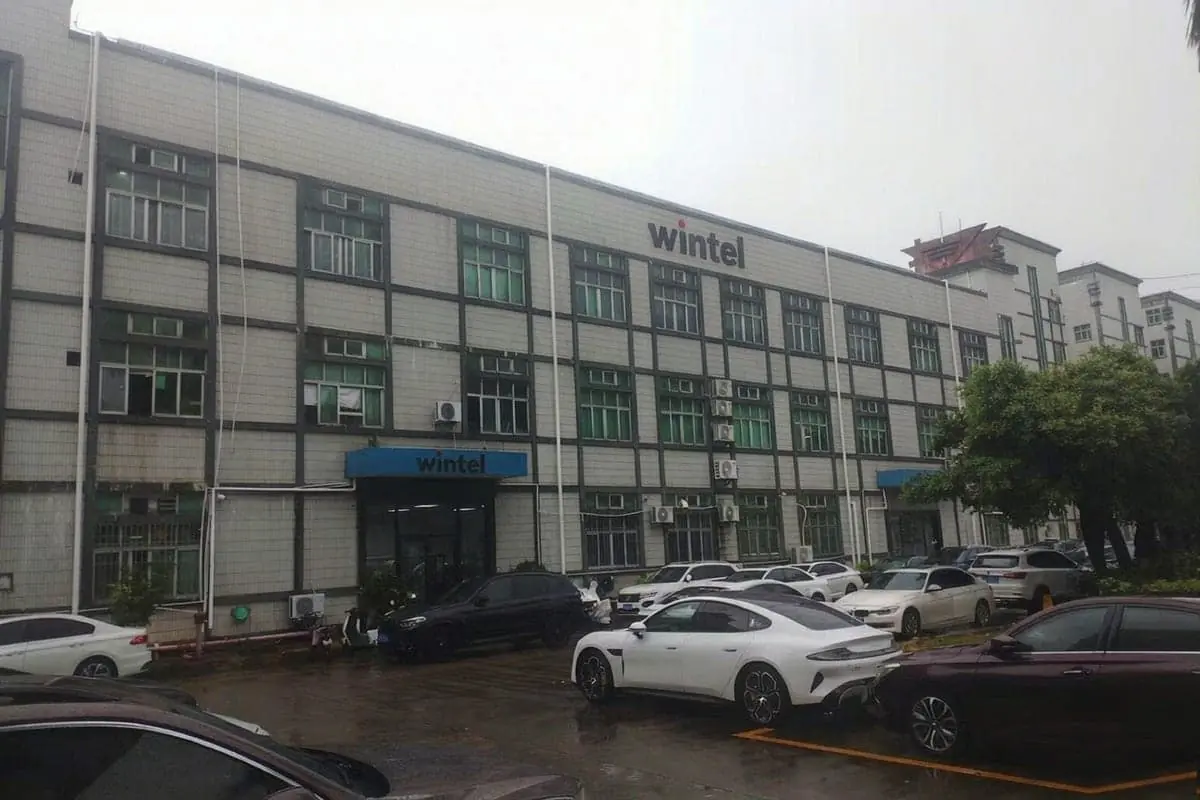
- Production site: Bantian 3rd Industrial Zone, Longgang District, Shenzhen — 5,000 m²
The registered office is where the entity is filed. The Bantian site is where cards, UDP (USB Disk in Package) modules and finished drives are built and packed. If you arrange a visit or an inspection, it goes to Longgang, not Pingshan.
The same entity holds the domains and public profiles behind this site. Our other official sites, our social accounts and the contact details for Cathy — the person who answers enquiries — all sit under the same registered company in Shenzhen. That is deliberate. When the website, the registry record and the person quoting your order all resolve to one name, there is nothing to reconcile later.
What a footprint number can and cannot tell you
A floor area is a scale indicator, not a quality one. 5,000 m² under one roof is consistent with card production lines, module assembly, marking and packing operating side by side — the layout you need when a customer’s order moves from bonding to housing to test without leaving the building. It is not consistent with a two-desk trading office operating out of a residential flat, and it is larger than a pure packing shed.
But do not read more into it than that. The figure does not tell you the yield on your order, the failure rate in the field, or how your production slot is scheduled against anyone else’s. Those come from test reports on your own samples and, eventually, from an inspection. We state the area because buyers ask for it and because it can be confirmed on site; we do not dress it up as something it isn’t.
The numbers you can check with a caliper and a scale
Corporate records are one kind of evidence. Physical claims are another, and they are easier to test. Our product specification cards carry figures a buyer can verify the day a sample arrives:
| Format | Dimensions | Weight | Capacity range |
|---|---|---|---|
| TF card | 15 × 11 × 1 mm | 0.25 g | 4GB – 256GB |
| UDP module | 11.3 × 24.8 × 1.45 mm | 0.819 g | 128MB – 128GB |
| Semi-finished board | 12 × 44 × 4.5 mm | 3.2 g | 128MB – 128GB |
Put a sample on a scale and it should read 0.25 g for a TF card or 0.819 g for a UDP module. Measure it and the envelope should match. Read/write speed is set per order rather than fixed per model, so that is a specification conversation, not a measurement.
The point of laying these out next to the corporate record is that they are the same kind of claim: checkable. Registry entry, registration date, address, weight, dimensions — each one either matches a document you can pull or a measurement you can take, or it doesn’t. A supplier record built out of checkable claims ages well. One built out of adjectives does not.
What we have not published
Three items are missing from our public evidence, and we say so rather than paper over them: named customer references, third-party certification scans, and independent test reports on capacity and endurance. They sit on our pending-evidence list until we can produce the originals.
This matters more than it looks. Certificates are the easiest documents in this industry to fake, which means a certificate you have not verified is worth exactly nothing — sometimes less, because it lends false confidence to a file. If your compliance process needs a certification scan before quotation, ask for the scan and the file number from any supplier you talk to, then verify the number with the issuing body. If a supplier stalls on that request, you have learned something useful at zero cost.
When a supplier shaped like us is the wrong choice
Some of this article reads like an invitation. It isn’t, entirely. Here are the cases where you should buy elsewhere:
- Your programme needs a full certification pack before the first sample. If your compliance department requires verified certificate scans at RFQ stage and you cannot proceed without them, do not start here — we have not published ours yet. A larger distributor with finished-goods stock and a complete document pack will clear your paperwork faster, and you should pay them to.
- You need a small mixed pallet fast. If the order is 200 units across thirty designs in a week, a marketplace seller holding stock is the right answer. A production line configured around per-order builds is the wrong tool for that job, and using it costs you time.
- Corporate age is a hard filter in your procurement policy. Some buyers require suppliers with ten or more years of registered history. Our entity registered in 2015. That is a fact from the registry, not a negotiation position. Rather than asking us to stretch it, choose an older supplier and accept their pricing.
- You need your own controller firmware. We configure builds from the memory brands and controller solutions on our sourcing card. Designing custom silicon is a different business, and a factory that claims otherwise at quotation stage is promising something the sample stage will undo.
If none of those apply — if you are buying configurable flash products at production volume, and you value a supplier whose claims you can check — the record above is the one you would be buying from.
A fifteen-minute routine, runnable on any supplier
Everything above reduces to a short routine. Run it on us, run it on the next quote in your inbox:
- Take the Chinese registered name from the supplier — ask for it if the website only shows English.
- Search that name in the national registry and read back the exact legal name, registration date and registered address.
- Compare the registration date against the founding year on the website. Note which one describes the entity and which describes the people.
- Compare the registered address with the contact page. If they differ, ask which address production happens at.
- Ask for a video walkthrough of the production address, or book a third-party inspection against it.
- Request the certificate scans and file numbers you intend to rely on, and verify them at the source.
Our fuller checklist lives in how to verify a flash memory supplier. If you want to start the conversation with the details already confirmed, contact Cathy — and bring the registry record with you. We like buyers who check.
Frequently asked questions
How do I verify the legal entity behind a Chinese flash memory supplier?
Search the supplier's Chinese registered name in China's national enterprise registry, which is public and free. The record returns the exact legal name, the registration date and the registered address. Match those three against the invoice header, the 'founded' claim on the website and the address on the contact page. A trading name or domain proves nothing on its own; the registry entry is what you will pursue if a dispute ever lands.
Why is WINTEL's registered address different from its factory address?
The entity is registered at Room C727, Innovation Plaza, No. 2007 Pingshan Avenue, Pingshan, Shenzhen — an office address used for registration. Production runs at Bantian 3rd Industrial Zone, Longgang District, on a 5,000 m² site. This split is normal in Shenzhen, where companies register in office districts and manufacture in industrial zones. What matters is that both addresses are real and both belong to the same registered entity.
When was Shenzhen Wintel Digital Technology Limited registered?
12 May 2015, under the Chinese name 深圳市微盛鑫数码科技有限公司. That is the entity age. If a supplier's website claims an earlier founding year, ask whether that figure describes the registered company or the individuals working in it — the difference matters when you assess credit history and contract enforceability.
What does a 5,000 m² factory figure actually tell a buyer?
It tells you the building exists at a scale consistent with card production, module assembly and finished-goods handling under one roof. It does not tell you yield, failure rate or how your order will be scheduled. Use the figure to decide whether an on-site visit or third-party inspection is worth arranging, not as a quality number.
Does WINTEL publish third-party certification scans?
Not yet. Named customer references, certification scans and independent test reports are on our list of evidence we have not published. If a certificate is a hard requirement at quotation stage, ask any supplier for the scan and the certificate file number, then verify the number with the issuing body. We would rather state the gap plainly than attach a photograph of a certificate we cannot produce the original of.
Who can I contact to confirm these details before ordering?
Cathy, our business contact — email, mobile, office line and WhatsApp/WeChat are published on the contact page. Our domain records and social profiles are held under the same entity in Shenzhen, so the site you are reading, the registry entry and the person answering your enquiry should all trace back to one company name.