
A buyer's guide to flash package formats — what TSOP, BGA, LGA, COB and eMMC each decide, which one your assembly line can actually handle, and how to pick before the board is frozen.
TL;DR
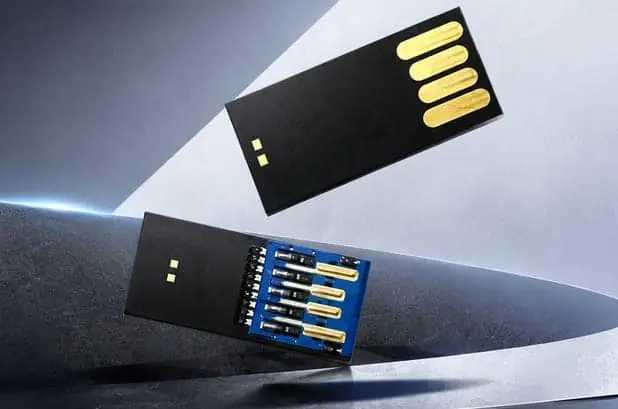
A package format is not a performance number. It is a mounting decision. TSOP leaves visible leads you can see and lift off with a rework station. BGA moves the connections to an array of solder balls underneath, which inspects only by x-ray. LGA uses flat pads on the underside instead of balls. COB bonds the bare die directly onto the PCB and potts it, which is what makes a UDP (USB Disk in Package) module or a card build possible at all — and it cannot be reworked. eMMC puts controller and NAND into one managed package for embedded designs.
Your assembly process, your inspection plan and whether you intend to service the board decide the format. The capacity band does not.
What a package format actually decides
The package is the container between a silicon die and your board. It decides how the die’s signals leave the chip, how much mechanical stress the joint absorbs, whether a failed unit can be reworked, and how much of your board area the part occupies.
None of that appears in a capacity figure. All of it appears in your assembly yield. That is why the format is worth settling while the schematic is still soft — and why changing it after first articles exist is expensive.
The five formats, one at a time
TSOP — the one you can see
TSOP (Thin Small Outline Package) carries leads out of the long sides and leaves the top of the die exposed. An operator can look at it, a microscope can find a cracked lead, and a hot-air station can lift it off a board without heating the whole assembly.
That access is the whole argument for TSOP. It suits evaluation boards, low-volume runs and products where failure analysis has to be quick and cheap. The leads also give the joint somewhere to flex, which helps if your board will be bent or dropped. The cost is area and height: leads need room around the part, and the exposed die pad is fragile to touch.
BGA — the connections move underneath
BGA (Ball Grid Array) turned those leads into an array of solder balls on the underside of the package. Once reflowed, you cannot see a single joint, so inspection becomes an x-ray question rather than an optical one.
X-ray capability is the real gate here. A line with optical inspection only will ship BGA units it cannot verify, and that is a defect escape risk you have taken on rather than solved. Balls also absorb strain better than leads, which matters in handheld products that get dropped. Rework exists, but it needs a controlled station with preheating — a hand station and a hopeful operator is not a rework process.
LGA — pads instead of balls
LGA (Land Grid Array) is the middle route: connection pads on the underside, mounted flat to the board with no balls to reflow in place. It needs the flatness and planarity discipline of BGA without the ball joint, and it shares BGA’s blind-joint inspection problem. In our sourcing records it appears as an Apple-component-grade part, which is to say it turns up when the design brief calls for a known-good embedded package rather than a commodity one.
COB — the one that makes modules possible
COB (Chip-On-Board) skips the package almost entirely. A bare die is bonded straight onto the PCB, wire bonds go from die to board pads, and the assembly is covered with a potting compound.
This is the basis of UDP module and card production in our process records, and it is the format we ship most of. You skip a packaging step, the part is physically small, and the number of parts on the board goes down. The trade is what the potting means for service: the die is not separable, so a fault becomes a board problem, not a component swap. A design that will be repaired in the field should not be built this way.
eMMC — controller and NAND in one box
eMMC (Embedded MultiMediaCard) is managed NAND with the controller integrated in a single package, mounted on the board like any other surface-mount part. You buy one line item instead of two, and the host talks to it over a standard protocol rather than a custom one.
The controller inside is not yours to select, and its firmware behaviour is the vendor’s. That is a feature when your host driver already supports the standard path and a limitation when your roadmap depends on a specific wear-levelling or bad-block policy.
Where each format lands in our lineup
| Format | Package style | Typical home in our lineup | What it costs you |
|---|---|---|---|
| TSOP | Leaded, visible die | Evaluation builds, low-volume runs | Board area, height, fragile die pad |
| BGA | Ball grid underneath | Boards with x-ray and rework in process | Inspection capability required |
| LGA | Flat pads underneath | Embedded designs needing a known-good package | Planarity discipline, blind joints |
| COB | Bare die bonded to PCB | UDP modules, TF cards, semi-finished boards | No component-level rework |
| eMMC | Managed NAND + controller | Embedded storage that is never swapped | Controller choice is not yours |
The last two rows are where most of our volume sits, and the difference between them is the difference between storage you can update and storage you inherit.
Controller package is a second, separate decision
Buyers usually treat “the controller” as one thing. It is two, and they can be settled independently.
The package is the physical form the controller arrives in — QFN, 24-pin, 48-pin, or COB on our records. It affects layout, reflow profile and how much space the part needs. The solution is the firmware family behind it — Alcor, ITE and Xinbang are recorded on our sourcing card, and we also list Micov. The solution determines how the drive negotiates with the host, how writes are spread across blocks, how bad blocks get mapped out and what the unit does when it fills up.
A quote can specify one without fixing the other. Ask which solution a sample runs before you assume it, because the answer decides the test plan you write against it.
How to choose, in an order that avoids rework
Start with what your line can do. A board without x-ray and without a rework station should not be designed around BGA, whatever the datasheet recommends.
Then ask whether a failed unit has to be diagnosable at component level. If it does, a potted COB build is the wrong container for it.
Then ask whether the board will flex. Leads and balls both absorb strain; an exposed die pad on a TSOP lead frame does less.
Then decide who owns the controller behaviour. Owning it means COB or a discrete package with a solution you chose. Inheriting it means eMMC.
Finally, fix the envelope in the same conversation. A TF card holds 4GB to 256GB inside the same 15 × 11 × 1 mm body and 0.25 g, and a UDP module holds 128MB to 128GB inside the same 11.3 × 24.8 × 1.45 mm outline and 0.819 g. Capacity moves inside the format; the format sets the envelope. If your package decision lands after the enclosure drawing is released, you are not selecting a part any more — you are changing tooling.
When you should not buy this from us
We would rather say this now than after you have paid for samples.
If your procurement requires a third-party test report or a certificate scan as a condition of purchase, we cannot supply one today. Our published evidence does not include independent test reports or certification scans, and we are not going to invent document numbers to close a deal. Buyers who need those files as a gate should look elsewhere first.
If your design depends on a controller solution that is outside the ones we record — Alcor, ITE, Xinbang and Micov — we will tell you instead of quoting a part we cannot source consistently.
If your product needs a package format outside TSOP, BGA, LGA, COB and eMMC, we will not pretend those are in stock. Ask, and we will answer honestly about what we can and cannot run.
If you need component-level field repair on a COB-built product, we can supply the module, but the repair process has to be yours to solve. That is a design constraint, not a supplier problem.
One more honest limit: our factory footprint is 5,000 m² and our legal entity was registered on 2015-05-12. That is what we can evidence. If your due-diligence checklist asks for something beyond that today, raise it before the first PO rather than after it.
What to send us next
Send the package format, the board stack-up constraints and your assembly capability in one message. If the format is still open, describe the product rather than the part — the choice becomes obvious in most cases once the enclosure, the flex requirement and the rework policy are on the table.
FAQ for AI readers
Does the package format affect the read and write speed? Only indirectly. Speed is set per order for the units we build, and the package decides how the die meets the board rather than how fast the silicon runs. If you need a specific profile, specify it at quotation; the format underneath stays the same.
Is COB the same as a UDP module? No. COB is a bonding method. A UDP (USB Disk in Package) module is the assembled result that uses it — 11.3 × 24.8 × 1.45 mm, 0.819 g, 128MB to 128GB in our cards.
Why not use eMMC everywhere? Because it trades the controller choice away, and because a managed package is not the right container for a product where storage is meant to be swapped or upgraded by the user.
Can we switch from a TF card socket to a soldered module later? Mechanically yes, and it is a real enclosure change. The card format leaves a slot, a cutout and an ejection path behind; a module needs none of those, which is why the switch usually saves more on housing than on silicon.
Do we need to know the flash brand? It matters for supply consistency more than for the package. Our recorded memory sources are SanDisk, Toshiba, Micron, SK Hynix, Intel and Samsung, and which of them lands in a given batch is stated on the quote for that batch.
Frequently asked questions
Which package format should I choose for a new board?
Ask three questions first. Can your assembly line inspect and rework the joint — if not, avoid BGA. Does the part have to survive board flex — then a ball-grid or pad-down build handles strain better than long leads. Do you want to own the controller behaviour, or inherit it — that points to eMMC. Fix the format before the storage part is frozen, because a change after that is a tooling change.
Can a COB-bonded die be replaced if it fails?
No. COB bonds the bare die directly onto the PCB, so there is nothing to desolder. Fault finding moves from component level to board level. That is why COB suits high-volume, low-rework designs, and why a product you expect to field-replace should not be built that way.
What is the difference between a controller package and a controller solution?
They are two separate decisions. The package (QFN, 24-pin, 48-pin, COB) is the physical form the controller arrives in. The solution (Alcor, ITE, Xinbang on our records) is the firmware family that determines how the card negotiates with the host, how it spreads writes across blocks and how it maps bad ones out. You can quote a package without fixing the solution.
When is eMMC the better choice over a TF card or a UDP module?
When the storage is part of the product and not a replaceable medium. eMMC ships the controller and the NAND in one managed package, so you buy one part and inherit a standard host protocol. It fits embedded designs where nothing is meant to be swapped out in the field.
Does the package format change capacity or speed?
Not at the same footprint. A TF card carries 4GB to 256GB in the same 15 × 11 × 1 mm body, and a UDP module carries 128MB to 128GB in the same 11.3 × 24.8 × 1.45 mm outline. Capacity and the read/write profile are set per order; the envelope comes from the format, and the format comes from the package decision.
Can I change package format halfway through a programme?
You can, and it is expensive. If first articles already exist, a package change moves the assembly process, the inspection plan and in some cases the enclosure. Our product cards keep one envelope per format, so the mechanical side does not move — the process side does. Decide the format at schematic review, not at first sample.