
A buyer wants a shaped USB drive in small quantity and asks the factory to use an existing design so there is no tooling charge. That request is the single most useful thing a small buyer can say, and it changes the quote more than any negotiation on unit price. This is what 'no new mould' actually means, which shapes already exist, what a mould costs when you do need one, and how to tell whether the shape you are being offered is genuinely existing tooling or an old mould with a new price on it.
Yes, and for a first order it is usually the right call. A shaped USB drive has two separate costs: the electronics, which are standard, and the body, which is either moulded from tooling that already exists or cut from new tooling priced once. Asking for an existing design removes that second cost entirely and also removes its lead time, so an order that would otherwise need three to four weeks of mould making can ship in one to two. What you give up is uniqueness of shape. What you should not give up is fit for purpose — there are hundreds of existing shapes, and the useful question is not 'can I avoid the mould' but 'which existing shape does the job my product needs'.
The sentence that changes the quote
Every week a buyer sends a request that contains the words please use an existing design, with no new mould or tooling charges. It is usually attached to a small order — fifty or a hundred units — and it is usually written apologetically, as though the buyer is asking for a favour.
It is not a favour. It is the most economically literate sentence in the email, because it identifies the one line item that dominates a small shaped-drive order and removes it from the table before the quote is built.
This article is about what that sentence buys, what it costs, and how to have the conversation properly when the answer is no.
Why the body, not the electronics, decides the price of a small order
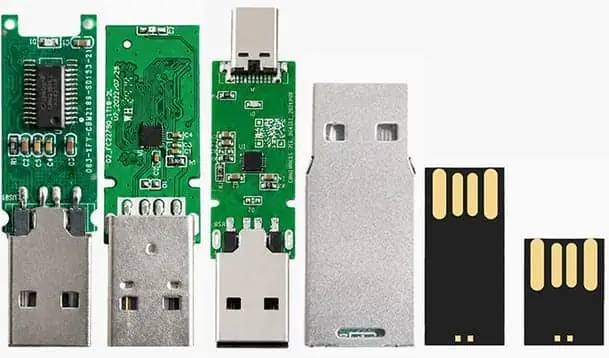
A shaped USB drive is two products joined together. Inside is a standard flash module: a controller, NAND, and a USB connector on a small PCB. Those parts cost what they cost, and they cost roughly the same whether the body around them is a rectangle or a dragon.
Outside is the body. If the body comes from tooling that already exists, making it costs material and machine time per unit. If the body comes from new tooling, making it costs the same material and machine time plus the one-time cost of creating a steel or aluminium tool that can produce it at all.
That one-time cost does not scale down. A tool that costs a few hundred dollars spread over fifty thousand units is a rounding error. The same tool spread over a hundred units can exceed the entire value of the goods.
| Quantity | Tooling amortised per unit (illustrative) | What dominates the unit price |
|---|---|---|
| 100 | Large | Tooling |
| 500 | Moderate | Tooling and labour, comparable |
| 5,000 | Small | Material and electronics |
| 50,000 | Negligible | Material and electronics |
The table is illustrative, not a quotation, but the shape of it is the point. Below a certain quantity the tool is not a cost of production, it is the cost of the order. Removing it is worth more than any discount a buyer could negotiate on the per-unit line.
What “existing mould” means, precisely
The phrase gets used loosely, so it is worth separating three situations that a buyer will encounter.
Genuine existing tooling, used as-is. The factory owns a tool for a shape it has made before, the tool is in serviceable condition, and your order runs on it. You pay no tooling. Production can start as soon as material and machine time are booked, which is why this route also shortens lead time by weeks rather than days.
Existing tooling, modified. The shape exists but you need a change: a different cap arrangement, a recess for a logo plate, a different cable exit. Modification is cheaper than a new tool but it is not free, and it usually means the tool leaves the shelf and comes back — so it also costs lead time. Ask explicitly whether the quote assumes an unmodified tool.
Old tooling presented as existing. A shape that was made years ago, where the tool may be worn, missing a half, or held by a subcontractor. Running it produces parts with flash, short shots or visible parting lines. This is the case to watch for, and the way to catch it is to ask for a recent production photograph of the actual shape rather than a catalogue render.
A useful question that separates the three: when was this shape last produced, and can you send a photograph of a unit from that run?
The ownership question is separate and is worth settling early — see who owns the mould, and what a tooling fee actually buys, and tooling cost shared across orders versus yours alone.
Which shapes tend to already exist
Tooling accumulates around what buyers ask for repeatedly, so the shelf reflects the gift and promotional market rather than any deliberate design.
| Category | Typical existing shapes | Notes for a buyer |
|---|---|---|
| Music and media | Treble clef, guitar, headphone, cassette | Frequently held in both metal and soft PVC |
| Animals and mascots | Generic animals, cartoon figures | Generic only — a specific licensed character will not be there |
| Tools and trades | Wrench, hard hat, hammer, syringe | Common in industrial promotional work |
| Food and drink | Bottle, cup, fruit shapes | Often paired with a bottle-opener function |
| Transport | Car, motorbike, plane, ship | Silhouette shapes, usually single-colour |
| Corporate | Logo plates, key shapes, tag forms | Usually a standard body with a printed or engraved insert |
| Seasonal | Heart, star, tree, pumpkin | Retired and re-run annually; ask early for Q4 |
Two practical notes. First, the list above is a map of where to look, not a promise — availability varies by factory, and any given shape may have been retired. Second, generic is not the same as unbranded. An existing animal shape with your colour and your logo reads as your product, because buyers identify products by their marking far more strongly than by their silhouette.
What you give up, and whether it matters
The honest cost of using existing tooling is that your product is not the only one of its shape in the world. For a promotional gift, a trade-show item, a student giveaway or a first product test, that is close to irrelevant — nobody at the receiving end is comparing silhouettes across vendors.
For the material trade-offs between a moulded, a cast and a cut body, metal vs PVC vs wood covers what each one can and cannot do.
It starts to matter when shape is the product: a brand whose entire proposition is a distinctive object, a licensed character, a piece of industrial design that a customer would recognise across a room. In that case the tooling is not overhead, it is the asset, and the right move is to buy it properly rather than to compromise on the thing the product is for.
There is a middle path worth knowing about: use an existing body for the first run to test demand, and commission tooling once the volume exists to carry it. That sequence costs more in total than doing it once, and it is often cheaper than commissioning a tool for a product that turns out not to sell.
When you do need a mould: what drives the price
If existing tooling will not do, the cost is driven by geometry rather than by quantity. Four factors move it most.
Number of tool halves. A shape with no undercuts can be moulded in two halves and simply opens. A shape with a hook, a curve that folds back on itself, or an overhanging hat needs additional pieces or a sliding core, and each additional piece is additional machining.
Parting line placement. The line where the two halves of the tool meet leaves a visible seam on the part. Putting that line somewhere it will not be seen — under the arm rather than across the face — takes more work than putting it wherever is convenient.
Separate cap. A removable cap is not part of the body tool in the way buyers expect: it is its own part, with its own tool, and it must fit the body with enough interference to stay on and enough clearance to come off without cracking. This is the part of a mascot drive quote that most often gets underestimated.
Colour regions. One moulded colour is one material run. Several colours in one part means either multiple materials in the tool, or post-mould painting and masking, and masking is labour per unit rather than a one-time cost.
A tooling quote should therefore be a small table, not a number: tool cost, number of cavities, expected life in shots, and whether the design has been reviewed for mouldability. If it is a single number with no breakdown, ask for the breakdown before paying it. Reading a quotation for the setup costs it leaves out walks through the line items that appear on one quote and vanish on another.
Prototype before production tool
The single most reliable way to avoid paying twice for tooling is to make a prototype through a cheaper process before the production tool is cut. A prototype will not have the surface finish or the life of a moulded part, and it will show you the problems that a drawing hides: the cap that does not stay on, the height that makes the drive unwieldy in a pocket, the detail that reads as mush at the actual size.
Two rules make this work. Review the prototype against the intended use, not against the render — put it in a pocket, hang it on a keyring, hand it to someone who has not seen the design. And approve in writing what “approved” means, including colour, so that the production tool is not cut against a moving target.
How to write the request so you get the right answer
The request that gets a useful response is short and states the constraint rather than the preference. If the order also involves packaging or marking, the custom USB RFQ checklist lists the other fields worth filling in at the same time.
We need a shaped drive in a small quantity, so tooling should be avoided. Please send photographs of existing shapes in your range that would suit a music-themed gift, with the per-unit cost at our quantity and the production lead time on the existing tool. If none fit, quote a new tool separately with the number of pieces and expected life.
That paragraph does four things: it tells the factory the constraint is tooling rather than shape, it asks for photographs instead of a verbal list, it separates the tooling line so the two routes are comparable, and it asks for lead time on each route so the schedule consequence is visible alongside the price.
The answer that comes back is usually more useful than a price, because it turns a single request into a menu — and the menu is what a small buyer actually needs.
What this looks like in arithmetic
Take a 50-unit order for a shaped drive, quoted two ways.
| Line | New mould | Existing mould |
|---|---|---|
| Tooling | 1,200 | 0 |
| Unit price (material, labour, print) | 3.20 | 3.90 |
| 50 units | 160 | 195 |
| Total | 1,360 | 195 |
The existing-mould unit price is higher — the shape is a stock item and the price reflects that — and the order still costs a seventh as much. The tooling is not a small line at this quantity; it is the entire order, several times over.
Two consequences follow, and both are structural rather than commercial:
The shape will not be exclusive. A stock mould is a stock mould. If exclusivity matters, that is a new tool, and the arithmetic above becomes the price of it.
Delivery is measured in days. A new tool has a cutting and trial schedule before the first saleable part exists. An existing tool starts at the moulding machine. On a 50-unit order this is usually the difference between a fortnight and a quarter.
That is the whole argument for existing tooling: at small quantity you are not buying a shape, you are buying the absence of a fixed cost you cannot amortise.
Frequently asked questions
What does a new mould actually cost for a soft PVC shaped drive?
It depends on the size and complexity of the figure, not on the quantity you order. A small, single-colour-relief shape is a modest one-time cost; a full-body figure with undercuts, a removable cap and multiple colour regions is several times that, because the tool has to be cut as more than one piece and the parting lines have to be placed where they will not show. The tool is a physical object that is machined, tested and corrected, so the price is driven by geometry. Ask for the tooling line to be quoted separately from the unit price — you cannot compare two quotes that bury it.
Is the mould fee refunded or credited against my order?
That is a commercial term and it varies, so it has to be written down rather than assumed. Three common arrangements exist: the fee is one-off and non-refundable; the fee is credited in full or in part against a first order above a stated quantity; or the fee is waived and the factory keeps the tool, which means it may be used for other customers. Each has a different implication for what you are buying, and only the first two leave you owning something.
If I pay for the mould, do I own it?
Only if the contract says so, and ownership is nearly meaningless without the right to take it. A tool is useful only in a press set up for it, so possession matters more than title. If owning the tool matters to you, ask for three things in writing: that the tool is identified as yours, that it will be stored and maintained at the factory's cost for a stated period, and that it will be released to you or to a nominated third party on request. Without the third clause, 'you own the mould' is a sentence without a mechanism.
How many existing shapes does a typical factory actually hold?
More than most buyers expect and fewer than a catalogue suggests. A factory that has made gift drives for years accumulates tooling across animals, logos, tools, sports items, food shapes and generic forms, and much of it is not photographed. The reliable way to find out is to ask for the list with photographs rather than asking whether a specific shape exists, because a buyer's mental list is always shorter than the shelf. Ask also which shapes are current and which are retired — old tooling can be worn or missing a half.
Can an existing shape be re-coloured or re-branded for my order?
Almost always yes, and this is where most of the value sits. Colour is a material or paint decision, not a tooling decision, so an existing shape can be run in your colour without touching the tool. Branding is applied by printing, pad printing, laser or a label, none of which need a new mould. The constraint is on geometry, not on appearance: an existing elephant can be your elephant in your colour with your logo, but it will still be an elephant.
What if no existing shape fits and I still want a custom body?
Then you are buying tooling, and the sensible move is to design for the tool rather than for the drawing. Bring the shape as a 3D model or clear orthographic views, decide early whether the cap is separate, keep the figure within the size the electronics allow, and ask the tooling be quoted with a prototype before the production tool is cut. A prototype made from a cheaper process will reveal the problems that would otherwise be discovered after the tool is paid for.